A novel tool for arrhythmic risk stratification in desmoplakin gene variant carriers

European Heart Journal

16 July 2024
Organised by: Logo
ESC Journals ARRHYTHMIAS AND DEVICE THERAPY

Abstract

AbstractBackground and Aims

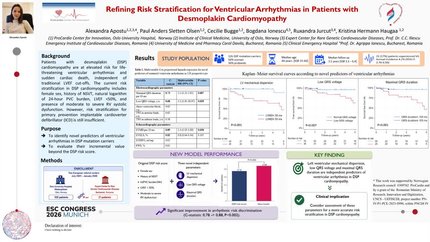
Pathogenic desmoplakin (DSP) gene variants are associated with the development of a distinct form of arrhythmogenic cardiomyopathy known as DSP cardiomyopathy. Patients harbouring these variants are at high risk for sustained ventricular arrhythmia (VA), but existing tools for individualized arrhythmic risk assessment have proven unreliable in this population.

Methods

Patients from the multi-national DSP-ERADOS (Desmoplakin SPecific Effort for a RAre Disease Outcome Study) Network patient registry who had pathogenic or likely pathogenic DSP variants and no sustained VA prior to enrolment were followed longitudinally for the development of first sustained VA event. Clinically guided, step-wise Cox regression analysis was used to develop a novel clinical tool predicting the development of incident VA. Model performance was assessed by c-statistic in both the model development cohort (n = 385) and in an external validation cohort (n = 86).

Results

In total, 471 DSP patients [mean age 37.8 years, 65.6% women, 38.6% probands, 26% with left ventricular ejection fraction (LVEF) < 50%] were followed for a median of 4.0 (interquartile range: 1.6–7.3) years; 71 experienced first sustained VA events {2.6% [95% confidence interval (CI): 2.0, 3.5] events/year}. Within the development cohort, five readily available clinical parameters were identified as independent predictors of VA and included in a novel DSP risk score: female sex [hazard ratio (HR) 1.9 (95% CI: 1.1–3.4)], history of non-sustained ventricular tachycardia [HR 1.7 (95% CI: 1.1–2.8)], natural logarithm of 24-h premature ventricular contraction burden [HR 1.3 (95% CI: 1.1–1.4)], LVEF < 50% [HR 1.5 (95% CI: .95–2.5)], and presence of moderate to severe right ventricular systolic dysfunction [HR 6.0 (95% CI: 2.9–12.5)]. The model demonstrated good risk discrimination within both the development [c-statistic .782 (95% CI: .77–.80)] and external validation [c-statistic .791 (95% CI: .75–.83)] cohorts. The negative predictive value for DSP patients in the external validation cohort deemed to be at low risk for VA (<5% at 5 years; n = 26) was 100%.

Conclusions

The DSP risk score is a novel model that leverages readily available clinical parameters to provide individualized VA risk assessment for DSP patients. This tool may help guide decision-making for primary prevention implantable cardioverter-defibrillator placement in this high-risk population and supports a gene-first risk stratification approach.

Contributors

Alessio Gasperetti
Alessio Gasperetti

Author

Johns Hopkins University Baltimore , United States of America

Alexandros Protonotarios

Author

University College London London , United Kingdom of Great Britain & Northern Ireland

Neal K Lakdawala
Neal K Lakdawala

Author

Brigham and Women's Hospital Boston , United States of America

Julia Cadrin-Tourigny

Author

Montreal Heart Institute Montreal , Canada

Iacopo Olivotto
Iacopo Olivotto

Author

University of Florence Florence , Italy

Elena Biagini
Elena Biagini

Author

IRCCS Sant'Orsola Polyclinic Bologna , Italy

Michela Casella
Michela Casella

Author

Marche Polytechnic University of Ancona Ancona , Italy

Giulio Conte
Giulio Conte

Author

Cardiocentro Ticino Institute Lugano , Switzerland

Jodie Ingles
Jodie Ingles

Author

Garvan Institute of Medical Research Sydney , Australia

Eric Schulze-Bahr
Eric Schulze-Bahr

Author

University Hospital Munster - UKM Muenster , Germany

Gianfranco Sinagra
Gianfranco Sinagra

Author

University of Trieste Trieste , Italy

Estelle Gandjbakhch
Estelle Gandjbakhch

Author

Pitie Salpetriere APHP University Hospital Paris , France