Closed loop stimulation reduces the incidence of atrial high-rate episodes compared with conventional rate-adaptive pacing in patients with sinus node dysfunctions
EP Europace Journal


Abstract
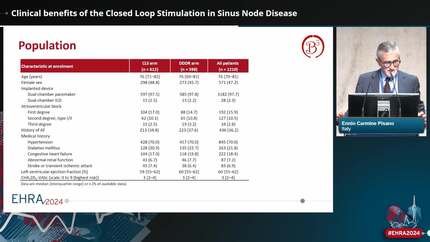
Subclinical atrial fibrillation (AF) is associated with increased risk of progression to clinical AF, stroke, and cardiovascular death. We hypothesized that in pacemaker patients requiring dual-chamber rate-adaptive (DDDR) pacing, closed loop stimulation (CLS) integrated into the circulatory control system through intra-cardiac impedance monitoring would reduce the occurrence of atrial high-rate episodes (AHREs) compared with conventional DDDR pacing.
Patients with sinus node dysfunctions (SNDs) and an implanted pacemaker or defibrillator were randomly allocated to dual-chamber CLS (
Dual-chamber CLS in patients with SND is associated with a significantly lower AHRE incidence than conventional DDDR pacing.
Contributors

Davide Saporito
Author
Maurizio Menichelli
Author
Antonino Nicosia
Author
Domenico M Carretta
Author
Aldo Coppolino
Author
Chi Keong Ching
Author

Álvaro Marco del Castillo
Author
Valeria Calvi
Author
Xi Su
Author
Miguel Viscusi
Author
Martina Del Maestro
Author
Daniele Giacopelli
Author
Ludovico Lazzari
Author
Alessio Gargaro
Author

Luca Bontempi
Author
Gemma Pelargonio
Author

Vincenzo Caccavo
Author
Chun-Chieh Wang
Author
Béla Merkely
Author
Lian-Yu Lin
Author
Il-young Oh
Author

You may be interested in