Real-world assessment of multipolar and point-by-point mapping for premature ventricular contraction ablation
EP Europace Journal


Abstract
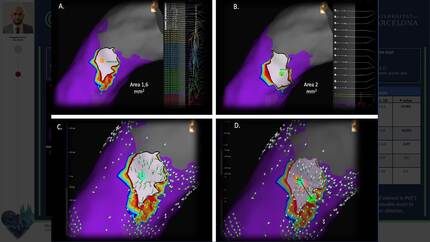
We aimed to assess the acute and midterm efficacy of premature ventricular contraction (PVC) ablation guided by multielectrode and point-by-point (PbP) mapping.
This is a retrospective, international multicentre study of consecutive patients referred for PVC ablation in 10 hospital centres from January 2017 to December 2021. Based on the mapping approach, two cohorts were identified: the ‘Multipolar group’, where a dedicated high-density mapping catheter was employed, and the ‘PbP group’, where mapping was performed with the ablation catheter. Procedural endpoints, safety, and acute (procedural) and midterm efficacies were assessed. Of the 698 patients included in this study, 592 received activation mapping [46% males, median age of 55 (41–65) years]—248 patients in the Multipolar group and 344 patients in the PbP group. A higher number of activation points [432 (217–843) vs. 95 (42–185),
The acute and midterm efficacies of PVC ablation are high with both multipolar and PbP mapping, although the former allows for quicker procedures and may potentially improve the outcomes of left-sided PVC ablation.
Contributors

Pedro A Sousa
Author

Johanna Tonko
Author
Imperial College London London , United Kingdom of Great Britain & Northern Ireland
Dagmara Dilling-Boer
Author
Sérgio Barra
Author

Borka Pezo
Author

Ziad Khoueiry
Author

Moisés Rodríguez-Mañero
Author
Ana Lebreiro
Author
Mariana Pereira
Author


Afonso Ferreira
Author
Carolina Saleiro
Author
Philippe Lagrange
Author
Luis Adão
Author
Joao de Sousa
Author
Luís Elvas
Author


John Silberbauer
Author
Sussex Cardiac Centre Brighton , United Kingdom of Great Britain & Northern Ireland
You may be interested in