Impact of environment and ethnicity on prognosis in AF patients: does the 'where' matter more than the 'who'?
EP Europace Journal


Abstract
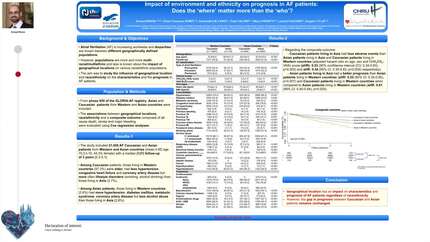
Atrial fibrillation (AF) is increasing worldwide and disparities are known between different geographically defined populations. However, populations are more and more multi-racial/multiethnic and less is known about the impact of geographical locations on various racial/ethnic populations.
To study the influence of geographical location and race/ethnicity on the characteristics and the prognosis in AF patients.
From phase II/III of the GLORIA-AF registry, Asian and Caucasian patients from Western and Asian countries were included. The associations between geographical locations, race/ethnicity and a composite outcome composed of all-cause death, stroke and major bleeding were evaluated using Cox regression analyses.
The study included 21,450 AF Caucasian and Asian patients from Western and Asian countries (mean±SD age 70.2±10; 44.3% female) with a median [IQR] follow-up of 3 years [2.3-3.1]. Among Caucasian patients, those living in Western countries (97.3%) were older, had less hypertension, congestive heart failure and coronary artery disease but more often lifestyle disorders (smoking, alcohol drinking) than those living in Asia (2.7%). Among Asian patients, those living in Western countries (2.6%) had more hypertension, diabetes mellitus, metabolic syndrome, coronary artery disease but less alcohol abuse than those living in Asia (2.6%). Regarding the composite outcome, Caucasian patients living in Asia had less adverse events than Asian patients living in Asia and Caucasian patients living in Western countries (adjusted hazard ratio on age, sex and CHA2DS2-VASc score (aHR): 0.53 (95% confidence interval (CI): 0.34-0.83), p=0.005) and aHR: 0.54 (95% CI: 0.35-0.83, p=0.005) respectively). Asian patients living in Asia had a better prognosis than Asian patients living in Western countries (aHR: 0.55 (95% CI: 0.35-0.85), p=0.007) and Caucasian patients living in Western countries when compared to Asian patients living in Western countries (aHR: 0.61 (95% CI: 0.40-0.94), p=0.025).
Geographical location has an impact on characteristics and prognosis of AF patients regardless of race/ethnicity. However, the gap in prognosis between Caucasian and Asian patients remains unchanged. Baseline characteristics. Kaplan-Meier curves.
Contributors


G F Romiti
Author
A M Fawzy
Author
P Calvert
Author

L Fauchier
Author

G Y H Lip
Author
University of Liverpool Liverpool , United Kingdom of Great Britain & Northern Ireland
You may be interested in