Optimising electrical performance of leadless cardiac resynchronisation therapy and leadless LV septal pacing
EP Europace Journal


Abstract
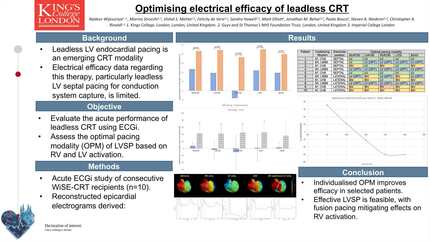
Leadless left ventricular (LV) endocardial pacing with the WiSE-CRT System is an emerging form of cardiac resynchronisation therapy (CRT). The system was designed to provide lateral wall LV pacing (LVP) via an endocardial receiver electrode in response to detection of a right ventricular pacing (RVP) stimulus from a co-implanted device, thereby delivering near-simultaneous biventricular pacing (BiVP). However, it is unclear whether BiVP generates the optimal electrical performance in this system, particularly in the context of leadless LV septal pacing, a novel use for leadless CRT.
We aimed to characterise the acute performance of leadless CRT at different pacing modalities using electrocardiographic imaging (ECGi).
Patients with the leadless CRT underwent an acute ECGi study. The following pacing modalities were tested: RVP; BiVP; LVP; and LVP with an electrically optimised atrioventricular delay (LV-OPT) in patients with sinus rhythm (SR). Reconstructed epicardial electrograms (Figure 1) were used to calculate BiV activation time (BIVAT-90), LV activation time (LVAT-90), RV activation time (RVAT-90), LV dyssynchrony index (LVDI), and BiV dyssynchrony index (BIVDI). For each metric, the improvement compared to baseline rhythm was calculated, and the optimal pacing modality (OPM) in each patient was determined.
Ten patients were studied, 5 receiving septal LVP, and 5 receiving lateral LVP. The underlying rhythm in 4 patients was SR with left bundle branch block (LBBB), and atrial fibrillation (AF) with complete heart block (CHB) in the remaining 6. BiVP generated a 23.7% improvement in BiVAT-90 compared to baseline (p=0.002). An individualised OPM resulted in a 43.3% BiVAT-90 improvement compared to baseline (p=0.0001), thus a 19.6% improvement compared to BiVP (p=0.02, Figure 2A). Using an OPM, BiVAT-90 was significantly improved in both patients with lateral (43.3%, p=0.0001) and septal LVP (42.4%, p=0.009). The BiVAT-90 OPM varied between patients (Figure 2B). BiVP was the OPM in 4/10 patients, all of whom had AF with CHB. BiVP was the OPM in 1/5 patients receiving LV septal pacing, with LVP or LV-OPT performing best in the remaining 4. In 3/4 patients in SR, LV-OPT was the OPM. Choosing the OPM increased performance primarily through significant improvements in RVAT-90 compared to BiVP (36.5% versus -8.2%, p =0.002).
Leadless CRT, both with lateral and septal LVP, significantly reduces electrical activation times and improves electrical dyssynchrony. Individualised selection of the OPM may be required with leadless CRT to accommodate for varying conduction disease phenotypes and implant locations.
Contributors

N Wijesuriya
Author
King's College London London , United Kingdom of Great Britain & Northern Ireland
M Strocchi
Author
V S Mehta
Author
St Bartholomew's Hospital London , United Kingdom of Great Britain & Northern Ireland
M K Elliott
Author
Barts Health NHS Trust London , United Kingdom of Great Britain & Northern Ireland
F De Vere
Author
S Howell
Author
N Mannakkara
Author
D Martic
Author
L Carlisle
Author
J Kwan
Author
Guy's and St Thomas' NHS Trust Hospitals London , United Kingdom of Great Britain & Northern Ireland
P Bosco
Author

S A Niederer
Author
Imperial College London London , United Kingdom of Great Britain & Northern Ireland
C A Rinaldi
Author
You may be interested in