Two-year safety and effectiveness of hybrid ablation versus catheter ablation in patients with non-paroxysmal AF: mid-term results of the CEASE-AF trial
EP Europace Journal


Abstract
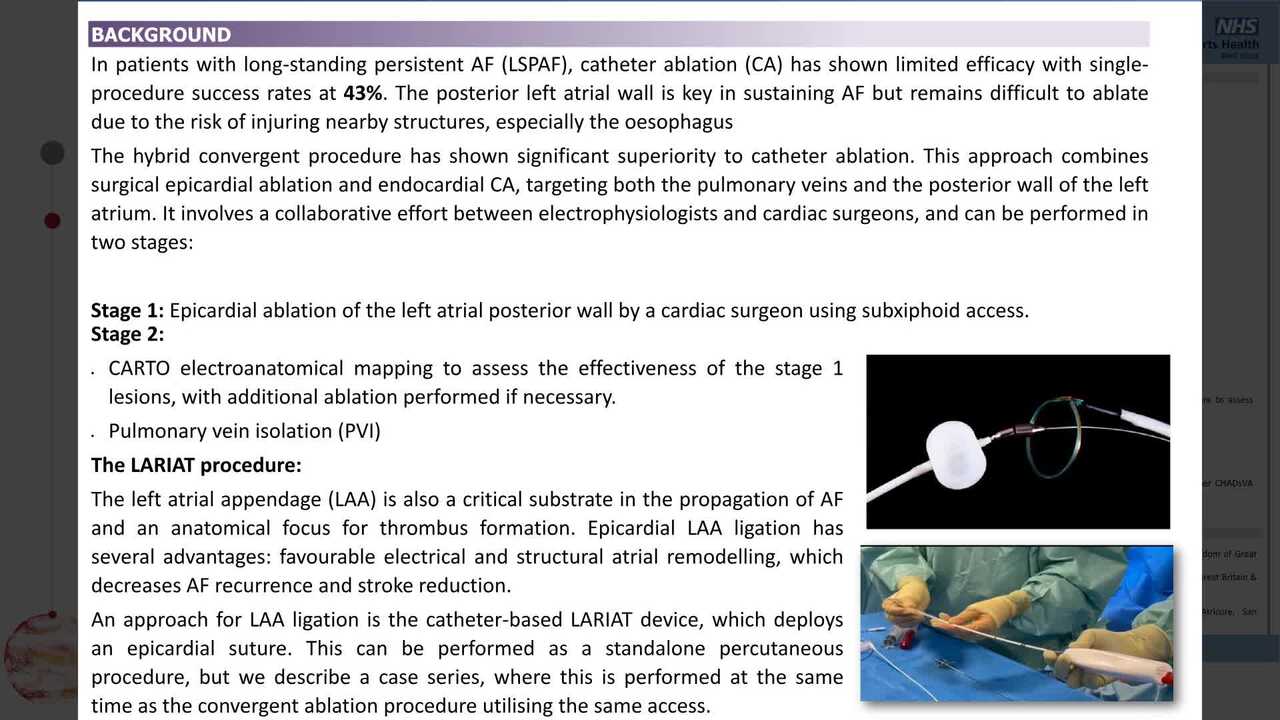
Hybrid Ablation for atrial fibrillation (AF) combines epicardial and endocardial ablation through a Heart Team approach to target durable, transmural isolation of the pulmonary veins (PV) and left atrial posterior wall (LAPW). While the primary efficacy endpoint at 12 months was met with a significant benefit increase for hybrid ablation, we now report the midterm durability of those results.
To evaluate 24-months safety and effectiveness of Hybrid Ablation with left atrial appendage exclusion (LAAE) versus Catheter Ablation in patients with persistent AF/enlarged left atrium and longstanding persistent AF (LSPAF).
CEASE-AF is a prospective, multi-center, 2:1 randomized controlled trial. Eligible patients were 18-75 years of age, had symptomatic, drug-refractory persistent AF and enlarged left atrium (>4 cm) or LSPAF, and were undergoing a first ablation. Hybrid Ablation consisted of two stages: thoracoscopic epicardial radiofrequency (RF) ablation for PV and LAPW isolation and epicardial LAAE followed by endocardial ablation 91-180 days later. Catheter Ablation consisted of minimum PV isolation by endocardial RF ablation, and repeat ablation was allowed between 91-180 days. In both arms, additional lesions were permitted according to institutional practices. Effectiveness was freedom from AF/atrial flutter (AFL)/atrial tachycardia (AT) off anti-arrhythmic drugs (AAD) (except AADs not exceeding doses which previously failed) and was assessed through 48-h Holter monitoring reviewed by an independent core laboratory blinded to the study. Safety was major adverse events throughout the study, adjudicated by an independent Clinical Events Committee.
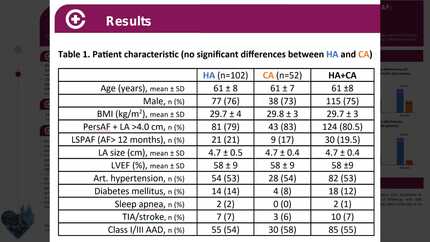
There were 102 Hybrid Ablation and 52 Catheter Ablation patients; 26% were female, mean age was 60.7±7.9 years, mean LAD was 4.7±0.4 cm, and 19% had LSPAF with no differences between arms. The 12- and 24-month results are shown for comparison (Table). Through 24-months, effectiveness was 66.3% (63/95) in the Hybrid Arm and 33.3% (17/51) in the Catheter Arm (absolute difference 33.0% [95% CI 14.3%, 48.3%; p<0.001]). Major adverse event rates through 24-months were statistically similar at 10.8% (11/102) in the Hybrid Arm and 9.6% (5/52) in the Catheter Arm (p=1.0). Through 24-months, repeat ablations were performed in 7.4% (7/95) of the Hybrid Arm versus 37.3% (19/51) of the Catheter Arm (p<0.001), and cardioversions were performed in 14.7% (14/95) of the Hybrid Arm versus 29.4% (15/51) of the Catheter Arm (p=0.034) Conclusions: CEASE-AF demonstrated that superior effectiveness of Hybrid Ablation including LAAE versus Catheter Ablation was durable through 24-month follow-up, with 33% absolute improvement in freedom from AF/AFL/AT. Safety rates continued to be similar between arms. Three-year follow-up is ongoing.
Contributors

P Suwalski
Author
National Institute of Medicine of the Ministry of Interior and Administration Warsaw , Poland

T Weimar
Author
D Kosior
Author
Central Research Hospital the Ministry of The Interior and Administration Warsaw , Poland
G Monnig
Author
J Sahu
Author
Sheffield Teaching Hospitals NHS Trust Sheffield , United Kingdom of Great Britain & Northern Ireland
S Hunter
Author
N Rub
Author
P Nemec
Author
T Ostrizek
Author
N Doll
Author
You may be interested in