JCAD promotes arterial thrombosis through PI3K/Akt modulation: a translational study

European Heart Journal

5 December 2022
Organised by: Logo
ESC Journals CORONARY ARTERY DISEASE, ACUTE CORONARY SYNDROMES, ACUTE CARDIAC CARE Acute Coronary Syndromes BASIC SCIENCE

Abstract

AbstractAims

Variants of the junctional cadherin 5 associated (JCAD) locus associate with acute coronary syndromes. JCAD promotes experimental atherosclerosis through the large tumor suppressor kinase 2 (LATS2)/Hippo pathway. This study investigates the role of JCAD in arterial thrombosis.

Methods and results

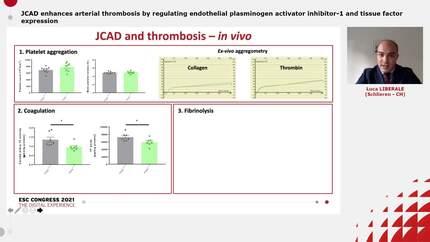
JCAD knockout (Jcad−/−) mice underwent photochemically induced endothelial injury to trigger arterial thrombosis. Primary human aortic endothelial cells (HAECs) treated with JCAD small interfering RNA (siJCAD), LATS2 small interfering RNA (siLATS2) or control siRNA (siSCR) were employed for in vitro assays. Plasma JCAD was measured in patients with chronic coronary syndrome or ST-elevation myocardial infarction (STEMI). Jcad−/− mice displayed reduced thrombogenicity as reflected by delayed time to carotid occlusion. Mechanisms include reduced activation of the coagulation cascade [reduced tissue factor (TF) expression and activity] and increased fibrinolysis [higher thrombus embolization episodes and D-dimer levels, reduced vascular plasminogen activator inhibitor (PAI)-1 expression]. In vitro, JCAD silencing inhibited TF and PAI-1 expression in HAECs. JCAD-silenced HAECs (siJCAD) displayed increased levels of LATS2 kinase. Yet, double JCAD and LATS2 silencing did not restore the control phenotype. si-JCAD HAECs showed increased levels of phosphoinositide 3-kinases (PI3K)/ proteinkinase B (Akt) activation, known to downregulate procoagulant expression. The PI3K/Akt pathway inhibitor—wortmannin—prevented the effect of JCAD silencing on TF and PAI-1, indicating a causative role. Also, co-immunoprecipitation unveiled a direct interaction between JCAD and Akt. Confirming in vitro findings, PI3K/Akt and P-yes-associated protein levels were higher in Jcad−/− animals. Lastly, as compared with chronic coronary syndrome, STEMI patients showed higher plasma JCAD, which notably correlated positively with both TF and PAI-1 levels.

Conclusions

JCAD promotes arterial thrombosis by modulating coagulation and fibrinolysis. Herein, reported translational data suggest JCAD as a potential therapeutic target for atherothrombosis.

Contributors

Luca Liberale
Luca Liberale

Author

University of Genoa Genova , Italy

Alexander Akhmedov
Alexander Akhmedov

Author

University of Zurich Zurich , Switzerland

Simon Kraler
Simon Kraler

Author

Bern University Hospital, Inselspital Bern , Switzerland

Konstantinos Stellos

Author

University of Heidelberg Heidelberg , Germany

Fabrizio Montecucco
Fabrizio Montecucco

Author

University of Genoa - Department of Health Sciences Genoa , Italy

ESC 365 is supported by