Electrocardiogram-based deep learning improves outcome prediction following cardiac resynchronization therapy
European Heart Journal


Abstract
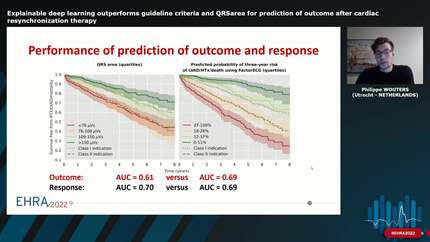
This study aims to identify and visualize electrocardiogram (ECG) features using an explainable deep learning–based algorithm to predict cardiac resynchronization therapy (CRT) outcome. Its performance is compared with current guideline ECG criteria and QRSAREA.
A deep learning algorithm, trained on 1.1 million ECGs from 251 473 patients, was used to compress the median beat ECG, thereby summarizing most ECG features into only 21 explainable factors (FactorECG). Pre-implantation ECGs of 1306 CRT patients from three academic centres were converted into their respective FactorECG. FactorECG predicted the combined clinical endpoint of death, left ventricular assist device, or heart transplantation [c-statistic 0.69, 95% confidence interval (CI) 0.66–0.72], significantly outperforming QRSAREA and guideline ECG criteria [c-statistic 0.61 (95% CI 0.58–0.64) and 0.57 (95% CI 0.54–0.60),
Requiring only a standard 12-lead ECG, FactorECG held superior discriminative ability for the prediction of clinical outcome when compared with guideline criteria and QRSAREA, without requiring additional clinical variables. End-to-end automated visualization of ECG features allows for an explainable algorithm, which may facilitate rapid uptake of this personalized decision-making tool in CRT.
Contributors


Rutger R van de Leur
Author
Melle B Vessies
Author
Antonius M W van Stipdonk
Author
Mohammed A Ghossein
Author
Rutger J Hassink
Author


Frits W Prinzen
Author
Kevin Vernooy
Author


You may be interested in