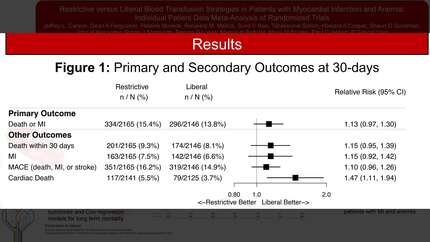
Economic evaluation of restrictive vs. liberal transfusion strategy following acute myocardial infarction (REALITY): trial-based cost–effectiveness and cost–utility analyses
European Heart Journal - Quality of Care and Clinical Outcomes


Abstract
To estimate the cost–effectiveness and cost–utility ratios of a restrictive vs. liberal transfusion strategy in acute myocardial infarction (AMI) patients with anaemia.
Patients (
The 30-day incremental cost–effectiveness ratio was €33 065 saved per additional MACE averted with the restrictive vs. liberal strategy, with an 84% probability for the restrictive strategy to be cost-saving and MACE-reducing (i.e. dominant). At 1 year, the point estimate of the cost–utility ratio was €191 500 saved per quality-adjusted life year gained; however, the cumulated MACE was outside the pre-specified non-inferiority margin, resulting in a decremental cost–effectiveness ratio with a point estimate of €72 000 saved per additional MACE with the restrictive strategy.
In patients with AMI and anaemia, the restrictive transfusion strategy was dominant (cost-saving and outcome-improving) at 30 days. At 1 year, the restrictive strategy remained cost-saving, but clinical non-inferiority on MACE was no longer maintained.
The use of a restrictive transfusion strategy in patients with acute myocardial infarction is associated with lower healthcare costs, but more evidence is needed to ascertain its long-term clinical impact.
Contributors

Isabelle Durand-Zaleski
Author
Gregory Ducrocq
Author
Maroua Mimouni
Author
Jerome Frenkiel
Author
Cristina Avendano-Solá
Author
Jose R Gonzalez-Juanatey
Author
Emile Ferrari
Author
Gilles Lemesle
Author

Laurence Berard
Author
Marine Cachanado
Author
Joan Albert Arnaiz
Author
Manuel Martínez-Sellés
Author

Albert Ariza-Solé
Author
Gonzalo Calvo
Author

Sandra Paco
Author
Elodie Drouet
Author
Helene Abergel
Author
Alexandra Rousseau
Author
Tabassome Simon
Author

You may be interested in