Incidence of ischaemic stroke and mortality in patients with acute coronary syndrome and first-time detected atrial fibrillation: a nationwide study
European Heart Journal


Abstract
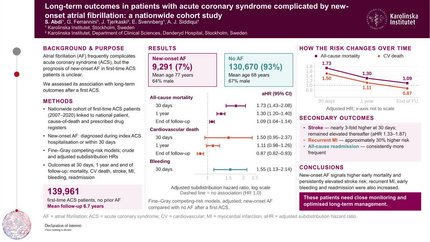
The aim of this study was to examine contemporary data on the 1-year prognosis of patients surviving acute coronary syndrome (ACS) and concomitant first-time detected atrial fibrillation (AF).
Using Danish nationwide registries, we identified all patients surviving a first-time admission with ACS from 2000 to 2018 and grouped them into (i) those without AF prior to or during ACS; (ii) those with a history of AF; and (iii) those with first-time detected AF during admission with ACS. With 1 year of follow-up, rates of ischaemic stroke, death, and bleeding were compared between study groups using multivariable adjusted Cox proportional hazards analysis. We included 161 266 ACS survivors: 135 878 (84.2%) without AF, 18 961 (11.8%) with history of AF, and 6427 (4.0%) with first-time detected AF at admission with ACS. Compared to those without AF, the adjusted 1-year rates of outcomes were as follows: ischaemic stroke [hazard ratio (HR) 1.38 (95% CI 1.22–1.56) for patients with history of AF and HR 1.67 (95% CI 1.38–2.01) for patients with first-time detected AF]; mortality [HR 1.25 (95% CI 1.21–1.31) for patients with history of AF and HR 1.52 (95% CI 1.43–1.62) for patients with first-time detected AF]; and bleeding [HR 1.22 (95% CI 1.14–1.30) for patients with history of AF and HR 1.28 (95% CI 1.15–1.43) for patients with first-time detected AF].
In patients with ACS, first-time detected AF appeared to be at least as strongly associated with the 1-year rates of ischaemic stroke, mortality, and bleeding as compared with patients with a history of AF.
Contributors


Jawad Haider Butt
Author


Christina Kruuse
Author

Anna Gundlund
Author

Emil Loldrup Fosbøl
Author
Lauge Østergaard
Author
You may be interested in