Prognostic impact of pericardial effusion in patients with acute myocarditis
European Heart Journal - Acute CardioVascular Care


Abstract
Recent Guidelines of the European Society of Cardiology have introduced the concept of
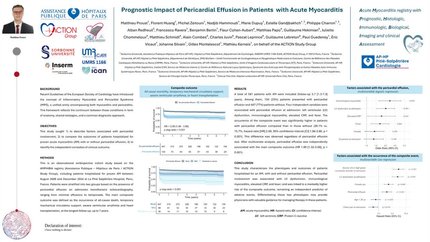
This is an observational ambispective cohort study based on the AMPHIBIA registry (Assistance Publique—Hôpitaux de Paris/ACTION Study Group), including patients hospitalized for proven AM between August 2008 and December 2024 at La Pitié Salpêtrière Hospital, Paris, France. Patients were stratified into two groups based on the presence of pericardial effusion on admission transthoracic echocardiography, ranging from minimal effusions to tamponade. The main composite outcome was defined as the occurrence of all-cause death, temporary mechanical circulatory support, severe ventricular arrhythmia, and heart transplantation, at the longest follow-up, up to 7 years. A total of 581 patients with AM were included [follow-up 3.7 (1.3–7.3) years]. Among them, 134 (23%) patients presented with pericardial effusion and 447 (77%) patients without. Four independent variables were associated with pericardial effusion at admission: left ventricular (LV) dysfunction, immunological myocarditis, elevated CRP, and fever. The occurrence of the composite event was significantly higher in patients with pericardial effusion compared to those without [38.1% vs. 15.7%, hazard ratio (HR) 2.69, 95% confidence interval (CI) (1.88–3.86),
This study characterizes the phenotypes and outcomes of patients hospitalized for an AM, with and without pericardial effusion. Pericardial involvement was associated with LV dysfunction, immunological myocarditis, elevated CRP, and fever and was linked to a markedly higher risk of the composite outcome, remaining an independent predictor of adverse events. Differentiating these two phenotypes may provide physicians with valuable guidance for managing therapy in these patients.
Contributors


Florent Huang
Author
Michel Zeitouni
Author
Nadjib Hammoudi
Author


Alban Redheuil
Author
Francesco Ravera
Author
Benjamin Bertin
Author
Fleur Cohen-Aubart
Author
Matthias Papo
Author
Guillaume Hekimian
Author
Juliette Chommeloux
Author
Matthieu Schmidt
Author
Alain Combes
Author
Charles Juvin
Author
Pascal Leprince
Author
Guillaume Lebreton
Author

Éric Vicaut
Author

Gilles Montalescot
Author
Mathieu Kerneis
Author
You may be interested in