Prevalence of exercise-induced arrhythmias in young athletes with fragmented QRS pattern in lead V1
European Journal of Preventive Cardiology


Abstract
Type of funding sources: None.
Resting 12-lead electrocardiogram (ECG) in apparently health athletes has specific pattern, typically associate to heart remodelling in response to regular exercise. (1,2) Moreover, these adaptations were correlated to typical ventricular arrhythmias, not associated with underlying cardiac abnormalities.(3) Recently, also fragmented QRS complex in lead V1 (fQRSV1), representing right ventricular (RV) activation, seems related to training-induced RV remodelling in athletes, where its prevalence is greater.(4)
Evaluate presence of fQRSV1pattern at resting ECG in a population of young athletes and its relationship with training-associated structural heart adaptations and exercise-induced ventricular arrhythmias.
This study retrospectively enrolled subjects who consecutively undergo to annual pre-participation screening and also to transthoracic echocardiography assessment, from January 2015 to September 2020. For each participant, medical history, physical examination, resting ECG, maximal standardized exercise test and echocardiographic evaluation were collected. All ECG were reviewed by two independent physicians to evaluate fQRSV1 pattern.
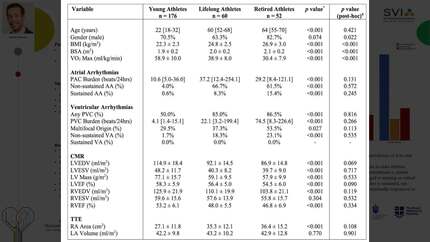
684 young athletes (mean age 14.87±1.96 years, 36% female) were included and the overall prevalence of fQRSV1was 27%. Figure 1 shows an example of fQRSV1 pattern. Principal subject characteristics and evaluations data are shown in Table 1. fQRSV1 subjects presented a significantly wider QRS interval (p=0.004) and lower heart rate at rest (p=0.001). Exercise workload expressed in METs and exercise duration were higher in subjects with fQRSV1 (p=0.002 and p=0.023, respectively). Echocardiographic data showed that subjects with fQRSV1differ in morphological and functional right ventricular (RV) characteristics, especially had a higher indexed RV end diastolic diameter (p=0.019) and higher TAPSE (p=0.013). Patients with fQRSV1did not show an increased occurrence of supraventricular or ventricular arrhythmias, regardless of morphology, neither for isolated nor for repetitive events.
Overall prevalence of fQRSV1 pattern in young athletes is comparable with the one studied in other population of adult athletes in previous studies. Adolescent athletes with fQRSV1 present structural heart characteristic that differ from subjects without this ECG pattern, especially in RV feature. No differences in prevalence of any type of exercise-induced arrhythmias was shown, especially in common ventricular arrhythmias consistent with origin from the right ventricular outflow tract, previously described in healthy athletes.
Figure 1
Table I
Contributors




You may be interested in