Assessing the impact of age on outcomes following percutaneous coronary intervention in patients undergoing transcatheter aortic valve replacement—a substudy in NOTION-3
European Heart Journal - Valvular and Structural Heart Disease


Abstract
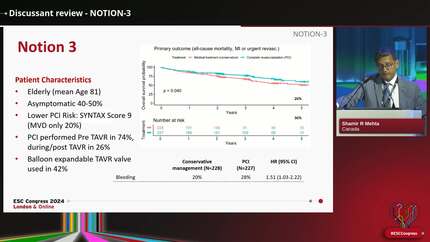
Findings from the recent NOTION-3 trial suggest that percutaneous coronary intervention (PCI) improves outcomes in patients with severe aortic stenosis and concomitant coronary artery disease undergoing transcatheter aortic valve implantation (TAVI). Whether the benefit of PCI is consistent across age groups is uncertain.
To investigate the impact of age on outcomes from NOTION-3.
A secondary analysis of 455 patients in the NOTION-3 trial, a randomized trial comparing PCI with conservative treatment in patients with aortic stenosis and coronary artery disease undergoing TAVI. Patients were stratified into four age groups based on the quartile distribution of age (<78, 78–81, 82–84, and ≥85 years) and followed for a median of 2 years (IQR: 1–4 years). The primary outcome was major adverse cardiac events defined as a composite of all-cause death, myocardial infarction, or urgent revascularization.
The risk difference for the primary endpoint comparing PCI and conservative treatment was most pronounced in patients aged 78–81 years [17% vs 42%; hazard ratio (HR): 0.36, 95% confidence interval (CI): 0.17–0.77,
In patients with coronary artery disease undergoing TAVI the benefit of PCI compared with conservative treatment on the composite of all-cause death, myocardial infarction, or urgent revascularization was most pronounced among patients aged 78–84 years.
Contributors

Burcu Tas Özbek
Author
Muhammad Sabbah
Author
Reza Jabbari
Author
Charlotte Glinge
Author
Karsten T Veien
Author
Matti Niemela
Author
Phillip Freeman
Author
Rickard Linder
Author
Dan Ioanes
Author
Christian J Terkelsen
Author
Olli A Kajander
Author
Sasha Koul
Author
Mikko Savontaus
Author
Evald H Christiansen
Author
Pasi Karjalainen
Author
Andrejs Erglis
Author
Jasmine M Marquard
Author
Lars Sondergaard
Author
Ole De Backer
Author

Jacob Lønborg
Author
You may be interested in