Baseline angina in patients with severe aortic stenosis and coronary artery disease: a secondary analysis of the NOTION-3 randomized controlled trial
European Heart Journal - Valvular and Structural Heart Disease


Abstract
Angina is common in patients with coronary artery disease and severe aortic stenosis. Whether angina should guide coronary revascularization in patients with severe aortic stenosis undergoing transcatheter aortic valve implantation (TAVI) remains uncertain.
This study aims to assess whether angina modifies the effect of percutaneous coronary intervention (PCI) on clinical outcomes and whether PCI influences angina burden after TAVI.
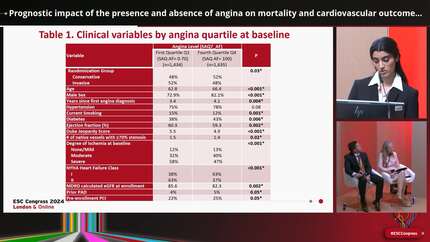
This prespecified secondary analysis of the NOTION-3 trial included patients with severe aortic stenosis and significant coronary artery disease randomized to TAVI with PCI or optimal medical therapy (OMT). Baseline angina was assessed by Seattle Angina Questionnaire-7 Angina Frequency score, supplemented by Canadian Cardiovascular Society class when questionnaire data were missing. Of 454 patients, 229 (50%) had angina and 225 (50%) had no angina. In the baseline angina subgroup, the primary outcome MACE, a composite of death from any cause, myocardial infarction, or urgent revascularization, occurred in 27% randomized to PCI vs 37% randomized to OMT. Without angina, rates were 26% vs 35%. Hazard ratios for PCI vs OMT were 0.71 (95% CI 0.45–1.13) in patients with angina and 0.69 (95% CI 0.43–1.12) in those without, with no interaction by baseline angina (
We found no evidence that baseline angina modified the relative effect of PCI on clinical outcomes, although the study was not powered to exclude clinically meaningful heterogeneity.
Contributors

Casper Ferreira Zimmer
Author
Jasmine Melissa Marquard
Author
Reza Jabbari
Author
Muhammad Sabbah
Author
Charlotte Glinge
Author
Karsten Tange Veien
Author
Matti Niemela
Author
Phillip Freeman
Author
Rickard Linder
Author
Lene Holmvang
Author
Dan Ioanes
Author
Christian Juhl Terkelsen
Author
Evald Høj Christiansen
Author
Ashkan Eftekhari
Author
Jarkko Piuhola
Author
Olli Kajander
Author
Sasha Koul
Author
Mikko Savontaus
Author
Pasi Karjalainen
Author
Andreas Rück
Author
Oskar Angerås
Author
Gintautas Bieliauskas
Author
Troels Højsgaard Jørgensen
Author
Lars Søndergaard
Author
Ole De Backer
Author

Jacob Lønborg
Author
You may be interested in