Temporal trends in atherosclerotic cardiovascular disease risk among U.S. adults. Analysis of the National Health and Nutrition Examination Survey, 1999–2018
European Journal of Preventive Cardiology


Abstract
Atherosclerotic cardiovascular diseases are a significant cause of disability and mortality. Study of trends in cardiovascular risk at a population level helps understand the overall cardiovascular health and the impact of primary prevention efforts.
To assess trends in the estimated 10-year atherosclerotic cardiovascular disease (ASCVD) risk among U.S. adults from 1999–2000 to 2017–18 with no established cardiovascular disease (CVD).
Serial cross-sectional analysis of National Health and Nutrition Examination Survey (NHANES) data from 1999–2000 to 2017–18 (10 cycles), including 24 022 US adults aged 40–79 years with no reported ASCVD. ASCVD risk was assessed using the pooled cohort equations (PCEs). There was a significant temporal decline in the mean 10-year ASCVD risk from 13.5% (95% CI, 12.5–14.4) in 1999–2000 to 11.1% (10.5–11.7) in 2011–12 (
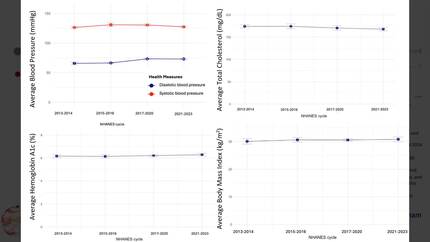
The 20-year trend of ASCVD risk among NHANES participants 40–79 years, as assessed by the use of PCE, showed a non-linear downward trend from 1999–2000 to 2017–18. The initial and significant decline in estimated ASCVD risk from 1999–2000 to 2011–12 subsequently stabilized, with no significant change from 2013–14 to 2017–18. Mean BMI and prevalence of diabetes mellitus increased while mean serum cholesterol levels and prevalence of smoking declined during the study period. Our findings support invigoration of efforts aimed at prevention of CVD, including primordial prevention of CVD risk factors.
Contributors

Muchi Ditah Chobufo
Author
Atul Singla
Author
Ebad Ur Rahman
Author

Erin D Michos
Author
The Johns Hopkins University School of Medicine Baltimore , United States of America
Paul K Whelton
Author
Sudarshan Balla
Author
West Virginia Institute Heart and Vascular Institute Morgantown , United States of America
You may be interested in