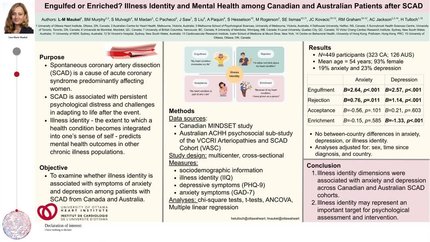
The impact of fear of recurrence and progression on mental health after spontaneous coronary artery dissection: the role of illness uncertainty
European Journal of Cardiovascular Nursing


Abstract
Spontaneous coronary artery dissection (SCAD) is a cause of acute myocardial infarction that is marked by a particularly challenging psychosocial recovery period. Survivors commonly experience fear of recurrent events and uncertainty around their condition. These psychosocial challenges may contribute to anxiety, depression, and cardiac distress. This study investigated the relationship between fear of recurrence and progression (FoRP), uncertainty, and psychological outcomes, specifically whether illness uncertainty moderates the relationship between FoRP and mental health outcomes in SCAD survivors.
Participants were recruited from the
The findings indicate specific intervention targets to meet the support needs of survivors. While fear of recurrent events is common following SCAD, managing illness uncertainty may be a means to reduce the impacts of this fear on survivor's mental health.
Contributors

Sarah T Clarke
Author
Michael R Le Grande
Author
Michelle C Rogerson
Author
Jason C Kovacic
Author
Stephanie Hesselson
Author
Siiri E Iismaa
Author
Robert M Graham
Author
Robert Hester
Author
You may be interested in