Incident heart failure in patients with screening-detected atrial fibrillation: a post hoc analysis of the STROKESTOP and STROKESTOP II studies

EP Europace Journal

3 September 2026
Organised by: Logo
ESC Journals ARRHYTHMIAS AND DEVICE THERAPY HEART FAILURE Acute Heart Failure Chronic Heart Failure Atrial Fibrillation (AF) PREVENTIVE CARDIOLOGY Risk Factors and Prevention

Abstract

AbstractAims

Atrial fibrillation is associated with increased risks of stroke, heart failure, and death. While stroke prevention is a key focus, heart failure is more frequent and a major contributor to mortality in atrial fibrillation. This study aimed to assess the incidence and timing of heart failure in screening-detected atrial fibrillation.

Methods and results

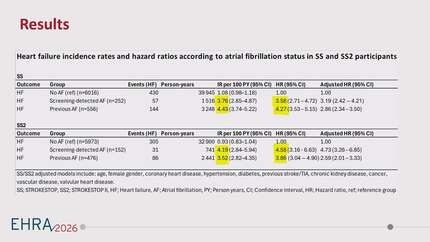
This post hoc analysis included participants without prior heart failure from the STROKESTOP and STROKESTOP II randomized screening studies, in which individuals aged 75–76 years were invited to ECG-based atrial fibrillation screening. Incident heart failure diagnoses were obtained from national registries. Incidence rates were calculated per 100 person-years, and Cox regression was used to estimate hazard ratios (HRs). In STROKESTOP, 23% of participants with screening-detected atrial fibrillation developed heart failure (3.76 per 100 person-years), compared with 4.43 in patients with known atrial fibrillation and 1.08 in patients without atrial fibrillation. Screening-detected atrial fibrillation was associated with a three-fold higher heart failure risk vs. no atrial fibrillation (adjusted HR 3.19) and a risk comparable to known atrial fibrillation (adjusted HR 2.86). In STROKESTOP II, 20% developed heart failure (4.19 per 100 person-years), compared with 3.52 in known atrial fibrillation and 0.93 without atrial fibrillation. Screening-detected atrial fibrillation was associated with a four-fold higher heart failure risk vs. no atrial fibrillation (adjusted HR 4.73) and a higher risk than known atrial fibrillation (adjusted HR 2.59).

Conclusion

Screening-detected atrial fibrillation is associated with a high risk of heart failure, comparable to known atrial fibrillation, and is not a benign condition.

Contributors