API-CAT investigators’ decisions on anticoagulation following extended treatment for cancer-associated thrombosis Clinical decisional uncertainty in extended anticoagulation for cancer-associated Thrombosis: the investigators' view before practice-changing evidence from the API-CAT trial
European Heart Journal - Cardiovascular Pharmacotherapy


Abstract
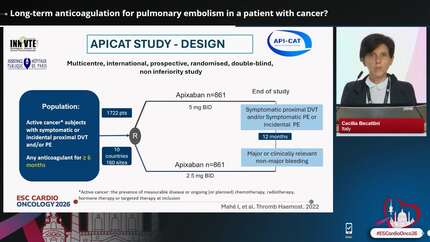
The API-CAT trial demonstrated that reduced-dose apixaban (2.5 mg twice daily) was noninferior to full-dose apixaban (5 mg twice daily) for the prevention of recurrent venous thromboembolism in patients with cancer, while resulting in fewer clinically relevant bleeding events. Although these findings are expected to influence clinical practice, real-world data on physicians’ anticoagulation decisions in this setting remain limited. To describe investigators’ anticoagulant treatment decisions for patients enrolled in the API-CAT trial after discontinuation of blinded study treatment and prior to trial unblinding and dissemination of results.
This descriptive analysis included patients from the prospective, multicentre, randomized, double-blind API-CAT trial who received at least one dose of study medication. Investigators prospectively documented anticoagulation management following either premature or planned discontinuation of blinded apixaban. Decisions were categorized as treatment discontinuation, continuation at a reduced dose, or continuation at a full dose. Descriptive analyses examined treatment choices according to patient characteristics, cancer features, and contextual factors. Of 1766 randomized patients, 1458 (82.6%) were included in the analysis. After discontinuation of study treatment, anticoagulation was stopped in 198 patients (13.6%) and continued in 1260 (86.4%). Among those continuing therapy, 790 patients (62.7%) received full-dose anticoagulation, 465 (36.9%) received a reduced dose, 5 unknown. Direct oral anticoagulants (DOACs) were prescribed in 89.6% of cases, and low-molecular-weight heparin in 9.9%. Treatment decisions were generally consistent across patient and cancer characteristics but varied according to timing of treatment discontinuation, physician specialty, and country.
Prior to unblinding of the API-CAT trial, treatment decisions appeared poorly driven by clinical characteristics, reflecting a ‘therapeutic grey zone’ where anticoagulation was continued in most patients but with highly variable dosing. This exploratory snapshot provides a baseline to monitor the anticipated shift towards wider adoption of reduced-dose apixaban for extended anticoagulation following publication of the API-CAT results. The substantial proportion of treatment discontinuation highlights the need for further studies to identify patients who may safely stop therapy.
API-CAT
Assistance Publique Hôpitaux de Paris, France
Contributors


Florent Happe
Author
Manuel Monreal
Author
Helia Robert-Ebadi
Author
Philippe Debourdeau
Author
Jean-Roch Fabreguettes
Author
Sandrine Accassat
Author
Patrick Mismetti
Author
Philippe Girard
Author
Silvy Laporte
Author
Céline Chapelle
Author
You may be interested in