Heart failure guideline-directed medical therapy in young adults with dystrophin-related cardiomyopathy: the HOPE-MD registry
European Heart Journal - Quality of Care and Clinical Outcomes


Abstract
Duchenne (DMD) and Becker (BMD) muscular dystrophies often progress to dilated cardiomyopathy and heart failure with reduced ejection fraction (HFrEF), a major cause of death in affected patients. Although guideline-directed medical therapy (GDMT) improves HFrEF outcomes, its real-world use in dystrophinopathies is poorly defined. We assessed GDMT utilization and optimization in the study population.
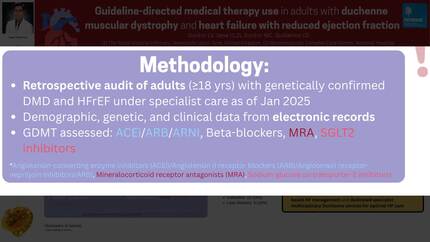
HOPE-MD (Heart failure treatment OPtimization in patiEnts with Muscular Dystrophy) is a European, multicentre, registry including adults with genetically confirmed DMD or BMD and left ventricular ejection fraction (LVEF) ≤ 40%. GDMT was defined as concurrent use of a renin–angiotensin system inhibitor (RASi), beta-blocker, mineralocorticoid receptor antagonist (MRA), and sodium–glucose cotransporter-2 inhibitor (SGLT2i). Doses were categorized as target (≥100%), intermediate (50–99%), or low (<50%). Among 274 patients (age, 28 years; LVEF, 35%; DMD, 80%), 44 (16%) received GDMT at baseline, with only one quarter at ≥50% of the target dose. Underutilization was greatest for MRAs (
In this European, multicentre registry, GDMT use and dose escalation were suboptimal in young patients with DMD/BMD and HFrEF.
Contributors

Luca Monzo
Author

Giulia Montrasio
Author
Valentina A Rossi
Author
Daniela Leone
Author
Kevin Duarte
Author
Carlo Pirazzi
Author
Priscilla Lamendola
Author
Marta Boi
Author
Entela Bollano
Author
Lance V Sese
Author
Christian L Polte
Author
Massimiliano Camilli
Author
Frank Ruschitzka
Author
Nicolas Girerd
Author
Kostantinos Savvatis
Author
Karim Wahbi
Author
You may be interested in