Electro-mechanical risk score for coronary artery disease risk estimation using seismocardiography
European Heart Journal - Digital Health


Abstract
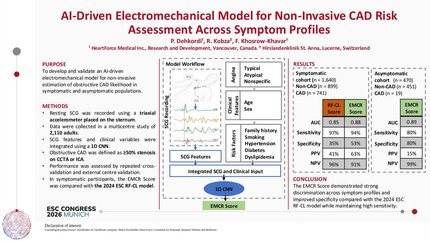
Coronary artery disease (CAD) remains a leading cause of morbidity. Existing clinical likelihood models often lack specificity, contributing to unnecessary diagnostic testing. To develop, train, and validate the electro-mechanical risk (EMR) Score. This machine learning model uses cardiac mechanical information from resting seismocardiography (SCG) recordings and patient-level clinical risk factors to estimate obstructive CAD likelihood.
This multi-centre clinical study included 2110 adults. Resting SCG was recorded using a sternum accelerometer. Obstructive CAD was defined as 50% or greater stenosis on coronary computed tomography angiography or invasive coronary angiography. A one-dimensional convolutional neural network was trained to compute the EMR Score. Performance was evaluated using repeated cross-validation and external-centre validation and compared with the 2024 ESC Risk-Factor–weighted Clinical Likelihood (RF-CL) model. Among 2110 participants (mean [SD] age, 57.8 [10.3] years; 801 women [38%]), 760 had obstructive CAD. In symptomatic individuals, the EMR Score achieved an AUC of 0.88, outperforming RF-CL (AUC, 0.85;
The EMR Score non-invasively estimated obstructive CAD likelihood, with external-centre validation supporting generalizability beyond internal cross-validation.
Contributors


Kouhyar Tavakolian
Author
Thomas Rocco
Author
Khurshid Fozilov
Author
Alisher Yuldashov
Author
Wojciech Zareba
Author
Baxtiyorjon Yuldashov
Author
Baxtiyor Atamuratov
Author
Hamid R Marateb
Author
Shukhrat Doniyorov
Author
Bernara Kurbanova
Author
Farzad Khosrow-Khavar
Author
You may be interested in