Comprehensive assessment of vasospastic angina using coronary computed tomography angiography: synergistic value of the presence of myocardial bridge, perivascular inflammation, and myocardial extracellular volume fraction
European Heart Journal - Cardiovascular Imaging


Abstract
Coronary computed tomography angiography (CCTA) has evolved beyond anatomical assessment to include sophisticated tissue characterization. While an elevated perivascular fat attenuation index around the right coronary artery (FAI-RCA) is known to reflect coronary inflammation in vasospastic angina (VSA), recurrent vasospasms may also induce chronic subclinical myocardial injury and subsequent remodelling, potentially associated with an increased myocardial extracellular volume fraction (ECV). However, the diagnostic integration of ECV and FAI-RCA for identifying VSA in patients with angina with non-obstructive coronary arteries (ANOCA) remains to be elucidated.
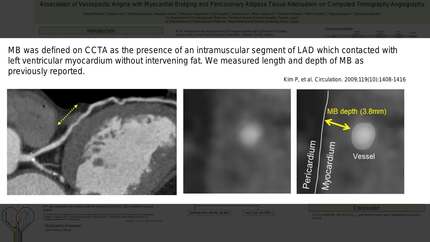
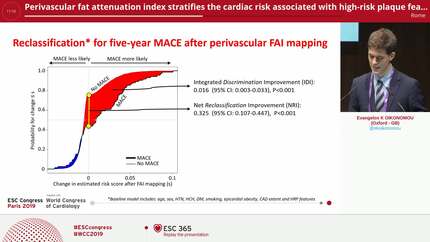
This study included consecutive ANOCA patients who underwent CCTA with a dedicated ECV protocol, followed by an invasive spasm provocation test. Comprehensive CCTA analysis quantified both FAI-RCA and the transmural ECV gradient (the difference between endocardial and epicardial ECV: ECVEndo − ECVEpi). Of the 100 patients analysed (mean age: 65.3 ± 11.8 years; 55% male), 27 were diagnosed with VSA. Multivariable logistic regression analysis identified transmural ECV gradient [odds ratio (OR): 1.12, 95% confidence interval (CI): 1.01–1.25], presence of myocardial bridging (MB) (OR: 3.49, 95% CI: 1.25–9.74), and high FAI-RCA (> −70.95 Hounsfield units [HU]) (OR: 5.79, 95% CI: 2.06–16.30) as significant independent predictors of VSA (all
A multi-parametric CCTA approach potentially identifies patients at high risk for VSA. The significant association of the transmural ECV gradient with VSA suggests that myocardial remodelling imaging provides a novel diagnostic window into the cumulative myocardial impact of vasospasm, independent of active adipose tissue inflammation and the presence of MB.
Contributors

Kodai Sayama
Author
Yoshihisa Kanaji
Author
Eisuke Usui
Author
Hiroki Ueno
Author
Tomohiro Tahara
Author
Takahiro Watanabe
Author
Riko Murakami
Author
Takashi Mineo
Author
Shunta Hiroi
Author

Kai Nogami
Author

Masahiro Hoshino
Author
Tomoyo Sugiyama
Author
Taishi Yonetsu
Author
Tetsuo Sasano
Author
You may be interested in