Enhanced risk stratification in hypertrophic cardiomyopathy through the integration of extracellular volume fraction on cardiovascular magnetic resonance
European Heart Journal - Cardiovascular Imaging


Abstract
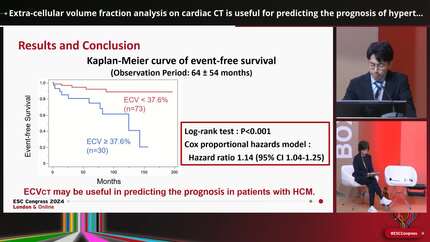
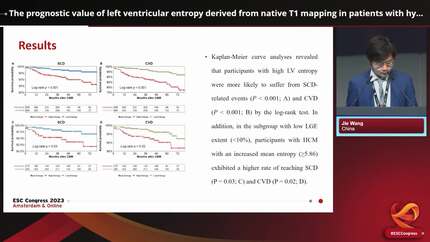
This study investigated the incremental prognostic value of cardiovascular magnetic resonance (CMR)-derived extracellular volume fraction (ECV), a marker of diffuse interstitial fibrosis, beyond late gadolinium enhancement (LGE) in hypertrophic cardiomyopathy (HCM).
We analysed 990 consecutive HCM patients (median age 58 years, male 68.3%) who underwent CMR between 2012 and 2024. LGE and global ECV were quantified, and their associations with the primary endpoint of HCM-related events—a composite of sudden cardiac death (SCD) events, heart failure (HF) events, and HCM-related death—were assessed. During a median follow-up of 3.2 years, 64 (6.5%) patients experienced the primary endpoint. While LGE (median 7.1%, IQR 2.3–16.9%) and ECV (median 29.0%, IQR 26.6–32.0%) were moderately correlated (
Increased ECV is an independent predictor of HCM-related outcomes. ECV may serve as a novel imaging biomarker to refine risk stratification in HCM patients who do not meet traditional LGE-based high-risk criteria.
Contributors

Hyun-Jung Lee
Author
Seo-Yeon Gwak
Author
Suji Lee
Author
Kyu Kim
Author
Iksung Cho
Author

Chi Young Shim
Author
Severance Cardiovascular Hospital, Yonsei University College of Medicine Seoul , Korea (Republic of)
Byoung Wook Choi
Author
Jong-Won Ha
Author
Young Jin Kim
Author

You may be interested in