Catecholaminergic polymorphic ventricular tachycardia mediated by ryanodine receptor 2: a validated risk stratification
European Heart Journal


Abstract
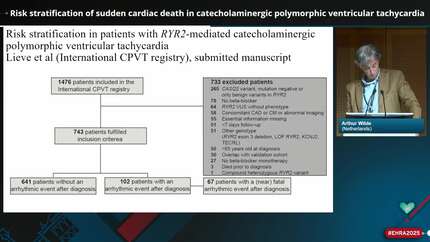
Patients with catecholaminergic polymorphic ventricular tachycardia (CPVT) are at risk for potentially life-threatening arrhythmic events (AEs) even while treated with β-blockers. The aim was to develop a model for individualized prediction of AEs in patients with
The derivation and independent validation cohorts included 743 and 129 patients, respectively. AEs were defined as arrhythmic syncope, appropriate implantable cardioverter–defibrillator shock, sudden cardiac arrest (SCA), and sudden cardiac death. Near-fatal or fatal AEs (nf/fAEs) included all AEs except for arrhythmic syncope. Prediction models using Cox regression were developed and internally and externally validated.
A total of 102 (13.7%) patients in the derivation cohort and 24 (18.6%) patients in the validation cohort experienced ≥1 AE over a median follow-up of 5.1 [interquartile range (IQR), 7.7] and 2.4 (IQR, 4.4) years, respectively. Predictors of AE were arrhythmic syncope or SCA prior to diagnosis and age at β-blocker initiation. In the derivation and validation cohorts, the optimism-corrected C-indices of the models for AE were 0.67 [95% confidence interval (CI) 0.62–0.72] and 0.59 (95% CI 0.48–0.71), respectively. For nf/fAEs, ventricular arrhythmia severity before β-blocker initiation was a fourth independent predictor, and C-indices of the models in the derivation and validation cohorts were 0.74 (95% CI 0.68–0.80) and 0.60 (95% CI 0.47–0.72), respectively. In the derivation cohort, calibration slopes were 1.00 (95% CI 0.59–1.41) for AE and 1.00 (95% CI 0.69–1.32) for nf/fAE.
These externally validated risk prediction models using clinical parameters accurately distinguished CPVT patients on β-blocker monotherapy at low and high risk for future AEs while treated with β-blockers. These models provide guidance for implementation of clinical management therapies to prevent AEs in patients with CPVT.
Contributors

Christian van der Werf
Author
Dania Kallas
Author
Isabelle Denjoy
Author
J Martijn Bos
Author
Takeshi Aiba
Author

Elijah R Behr
Author
City St George's University of London London , United Kingdom of Great Britain & Northern Ireland
Maarten P van den Berg
Author
Nico A Blom
Author
Martin Borggrefe
Author
Ramon Brugada
Author
Lidia María Carrillo Mora
Author
Ehud Chorin
Author
Lia Crotti
Author
Andrew Davis
Author
Fabrizio Drago
Author
Veronica Dusi
Author
Fabrice Extramiana
Author
Sonia Franciosi
Author


Freek van den Heuvel
Author

Janneke Kammeraad
Author
Prince J Kannankeril
Author
Habib R Khan
Author
Andrew D Krahn
Author
Ciorsti MacIntyre
Author
Alice Maltret
Author
Annukka Marjamaa
Author
Seiko Ohno
Author
Puck J Peltenburg
Author
Guillermo J Perez
Author
Vincent Probst
Author
Jason D Roberts
Author
Tomas Robyns
Author
Christine Rootwelt-Norberg
Author
Ferran Roses I. Noguer
Author
Thomas M Roston
Author
Annika Rydberg
Author
Frederic Sacher
Author


Christopher Semsarian
Author

Luke Starling
Author
Naokata Sumitomo
Author
Jonathan R Skinner
Author
Terezia Tavacova
Author

Janice A Till
Author

Yuko Wada
Author
Fernando Wangüemert
Author
Esther Zorio
Author
Michael J Ackerman
Author
Antoine Leenhardt
Author
Shubhayan Sanatani
Author

Arthur A Wilde
Author
You may be interested in