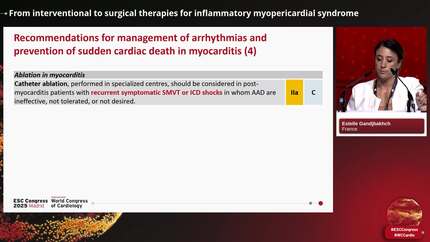
Workup and management of rhythm disorders in myocarditis and inflammatory cardiomyopathy: a clinical consensus statement of the European Heart Rhythm Association and the Heart Failure Association of the ESC, the ESC Working Group on Myocardial & Pericardial Diseases, the European Association of Preventive Cardiology of the ESC, the Heart Rhythm Society, the Asian Pacific Heart Rhythm Society, and the Latin American Heart Rhythm Society
EP Europace Journal


Abstract
Myocarditis is an important and frequently underrecognized cause of atrioventricular conduction disease and ventricular arrhythmias and may also be associated with atrial arrhythmias and sinus node dysfunction. Arrhythmic risk evolves over time as a result of the interplay between myocardial inflammation, fibrosis, and genetic predisposition. Despite its clinical relevance, guidance for the diagnosis, treatment, and follow-up of arrhythmias in myocarditis has remained limited. This consensus statement provides a structured framework for the management of arrhythmias in myocarditis and inflammatory cardiomyopathy (Infl-CMP), integrating disease phase and genetic background into clinical decision-making. It offers practical guidance across the disease spectrum, including diagnostic evaluation, therapeutic strategies, and longitudinal follow-up. The document was jointly developed by the European Heart Rhythm Association of the European Society of Cardiology (ESC) in collaboration with the Heart Failure Association of the ESC, the ESC Working Group on Myocardial & Pericardial Diseases, and the European Association of Preventive Cardiology of the ESC, together with the Heart Rhythm Society, the Asia Pacific Heart Rhythm Society, and the Latin American Heart Rhythm Society. Consensus advice is organized using a phase-aware framework distinguishing hot, hot-to-cold, and cold phases, with clinical consensus statements graded according to opinion-, observational-, or randomized trial-based evidence and supported by formal author voting. Arrhythmia management is stratified by disease phase. During active inflammation, antiarrhythmic therapy is combined with aetiology-targeted treatment or immunosuppression when indicated. In later stages, substrate-based strategies include pharmacological therapy, device implantation, or ablation. Emphasis is placed on hot-to-cold transition as an arrhythmogenic window and on risk stratification.
Contributors



Antonio Berruezo
Author
Entela Bollano
Author


Micaela Ebert
Author
Sabiha Gati
Author

Koshiro Kanaoka
Author

Enrique Asensio-Lafuente
Author

Alexander Álvarez Ortiz
Author

Antonis Pantazis
Author
Guy's and St Thomas' NHS Trust Hospitals London , United Kingdom of Great Britain & Northern Ireland
Jayasree Pillarisetti
Author

Giuseppe Rosano
Author
St Georges Medical School London , United Kingdom of Great Britain & Northern Ireland
Petar M Seferović
Author


Katja Zeppenfeld
Author

You may be interested in