Decentralized community-based hub-intermediary-spoke model for rapid cardiac ultrasound triage for early heart failure detection: findings from the Heart2Miss initiative
European Heart Journal - Digital Health


Abstract
To evaluate the feasibility and system-level performance of Heart2Miss, a decentralized community-based triage model deploying AI-powered point-of-care ultrasound (AI-POCUS) via a hub-intermediary-spoke approach in diabetes primary care for early heart-failure (HF) detection.
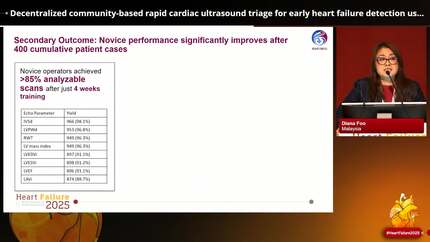
In this prospective study, 1000 adults with diabetes and no known HF were screened over seven months across six primary care clinics (spokes); 985 with complete data were analysed. Novice biomedical and bioscience graduates underwent 4-week training to perform focused three-view handheld AI-POCUS. Images were AI-analysed and verified through the hub–intermediary–spoke pathway. The primary outcome was detection of previously undiagnosed HF. Secondary outcomes included reduction in tertiary-centre burden through the hub–intermediary–spoke pathway and novice sonographer performance. 11.1% (
This decentralized hub–intermediary–spoke model combining AI-POCUS, telehealth verification, and a task-shifted bioscience workforce enabled early HF detection while substantially reducing specialist workload, supporting digital health-enabled workforce innovation and pathway redesign in resource-constrained settings.
Contributors


John Jui Ping Yeo
Author
Stephanie Tayas Bumphray
Author
Rose Hui Chin Jong
Author
Claudia Lennya Jana
Author
Jennett Michael
Author
Maziah Ishak
Author
Peter Jerampang
Author
Maila Mustapha
Author
Sally Suriani Ahip
Author
Lenny Hamden
Author
Macnicholson Igo
Author
Mohammad Nor Azlan Sulaiman
Author

Francesca Gelang Chong
Author
Deborah Berenai Enggong
Author
Yeequant Chung
Author
Daniel Ishak
Author
Angela Melinda Anthony Jalin
Author
Sonesh Kalra
Author
Alan Yean Yip Fong
Author
You may be interested in