Conduction system vs. biventricular pacing in heart failure with reduced ejection fraction: a meta-analysis of randomized controlled trials
EP Europace Journal


Abstract
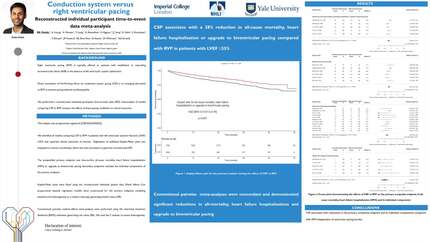
Conduction system pacing (CSP) has emerged as a physiologic alternative to cardiac resynchronization therapy (CRT) with biventricular pacing (BiVP) in heart failure with reduced ejection fraction (HFrEF), yet its comparative effects remain uncertain. This meta-analysis sought to compare outcomes of CSP vs. BiVP in patients with HFrEF undergoing CRT.
MEDLINE, Embase, Scopus, and the Cochrane Database were searched through 4 May 2026. Randomized controlled trials (RCTs) were synthesized using random-effects meta-analysis. Thirteen RCTs including 1320 participants were analysed (657 CSP, 663 BiVP). Conduction system pacing was associated with a lower risk of the composite of hospitalization for heart failure (HHF) or all-cause mortality compared with BiVP (46 vs. 83 events; odds ratio [OR] 0.51, 95% confidence interval [CI] 0.28–0.93). No significant differences were observed for HHF alone (OR 0.68, 95% CI 0.36–1.27) or all-cause mortality (OR 0.75, 95% CI 0.36–1.58). Conduction system pacing was associated with greater improvement in the 6-min walk distance (mean difference [MD] 21.53 m, 95% CI 4.33–38.73) and New York Heart Association functional class (standardized mean difference [SMD] −0.27, 95% CI −0.47 to −0.07), but not quality of life. Conduction system pacing also reduced QRS duration compared with BiVP (MD −10.94 ms, 95% CI −17.55 to −4.34), with no significant differences in left ventricular ejection fraction, left ventricular end-systolic volume, overall pacing threshold, total procedure time, fluoroscopy time, any complication, or reintervention.
In patients with HFrEF undergoing CRT, CSP is associated with lower composite risk of HHF or all-cause mortality compared with BiVP. Conduction system pacing is also associated with improved functional capacity, without significant differences in safety or procedural outcomes.
Contributors


Konstantinos Vlachos
Author
Konstantinos C Siontis
Author

Stylianos Tzeis
Author


Konstantinos Pamporis
Author
National & Kapodistrian University of Athens Medical School Athens , Greece

Antonios P Antoniadis
Author


Nikolaos Fragakis
Author
You may be interested in