Pharmacological treatment after a first myocardial infarction in Sweden—long-term adherence and prognosis
European Heart Journal - Quality of Care and Clinical Outcomes


Abstract
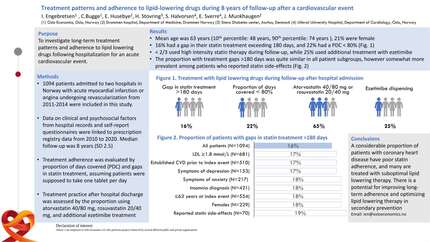
Optimizing pharmacological treatment for secondary prevention after myocardial infarction (MI) is crucial to prevent new events, but few have reported data over a long-term follow-up. The aim was to study long-term follow-up of guideline-directed medical therapy (GDMT) as a part of secondary prevention after MI.
Patients aged 18–84 years, hospitalized with a first acute MI between 2006 and 2022 were identified through the Swedish National Inpatient Register linked to the Prescribed Drug Register. GDMT was defined as antiplatelet/oral anticoagulant therapy (OAC), lipid lowering therapy, beta-blockers and angiotensin converting enzyme inhibitors (ACEi)/angiotensin receptor blockers (ARB). Time-updated survival analyses were used to investigate the relationship between GDMT and mortality and/or recurrent MI. A total of 96 272 individuals with acute MI were included (29.3% women). At baseline 48.4% had hypertension, 18.8% diabetes mellitus and 13.5% heart failure. Use of GDMT decreased markedly during the first year after MI. During median follow-up of 5.6 years 32.9% died. Medication with antiplatelet/OAC, lipid lowering treatment and ACEi/ARB were associated with lower risk of all cause-mortality or recurrent MI hazard ratio (HR) 0.76 [95% confidence interval (CI) 0.74–0.78], HR 0.68 [95% CI 0.67–0.70], HR 0.81 [95% CI 0.79–0.83] respectively (all
The use of all GDMT is associated with lower risk for all-cause mortality and recurrent myocardial infarction. Long-term adherence of GDMT is suboptimal and there is a potential for further improvement.
Contributors



You may be interested in