Early recurrence of atrial tachyarrhythmia after catheter ablation and its associations with clinical outcomes, atrial fibrillation burden, and blanking period duration: a post hoc analysis of the CABANA trial
EP Europace Journal


Abstract
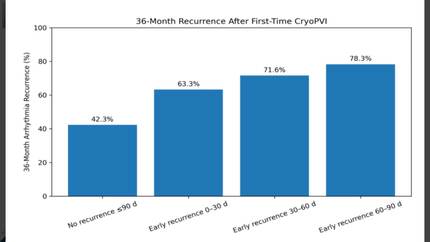
Early recurrence of atrial tachyarrhythmia (ERAT) after catheter ablation for atrial fibrillation (AF) is common, yet its prognostic significance and implications for the duration of the blanking period remain uncertain. We aimed to evaluate the association between ERAT and post-ablation clinical outcomes, late arrhythmia recurrence, and AF burden, and to explore the optimal duration of the blanking period.
This
ERAT was associated with higher risks of cardiovascular hospitalization and late atrial tachyarrhythmia recurrence in a time-dependent manner, supporting a shorter blanking period to better identify patients at risk of adverse rhythm outcomes.
Contributors

Yang Chen
Author
University of Liverpool Liverpool , United Kingdom of Great Britain & Northern Ireland

Gregory Y H Lip
Author
University of Liverpool Liverpool , United Kingdom of Great Britain & Northern Ireland

Hongyu Liu
Author
Runhui Hu
Author
Wenhui Li
Author
Eva Soler-Espejo
Author

Yang Liu
Author
Manlin Zhao
Author
Tianshu Gu
Author
Weiguo Fan
Author
Bi Huang
Author

Dhiraj Gupta
Author
Liverpool Heart and Chest Hospital Liverpool , United Kingdom of Great Britain & Northern Ireland
Douglas L Packer
Author
You may be interested in