The junctional protein associated with coronary artery disease predicts adverse cardiovascular events in patients with acute coronary syndromes at high residual risk
European Heart Journal


Abstract
Patients with acute coronary syndromes (ACS) are at high ischaemic risk to which cholesterol, inflammation, and yet-to-be-identified pathways jointly contribute. The
In the discovery cohort (SPUM-ACS;
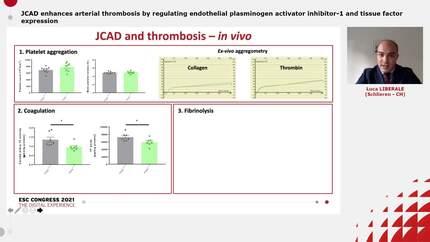
At 1 year, patients at RLR, RIR, or RILR were at higher MACE risk as compared to controls [hazard ratio (HR), 1.55, 95% confidence interval (CI) 1.08–2.23; HR 1.80, 95% CI 1.24–2.61; and HR 1.75, 95% CI 1.12–2.75, respectively]. In those at RLR, MACE risk rose with increasing hs-CRP and JCAD, respectively, in uni- (HR per log2 increase, 1.17, 95% CI 1.06–1.30; HR 1.29, 95% CI 1.03–1.62) and multivariable-adjusted models [adjusted (a)HR 1.16, 95% CI 1.03–1.30; aHR 1.27, 95% CI 1.01–1.60]. In those at RIR, MACE risk increased 1.28-fold per log2 increase in JCAD (HR 1.28, 95% CI 1.03–1.59), which prevailed in multivariable-adjusted models (aHR 1.31, 95% CI 1.04–1.65). Similarly, in patients at RILR, MACE risk increased almost linearly with increasing JCAD (HR 1.45, 95% CI 1.09–1.92), independently of potential confounders (aHR 1.47, 95% CI 1.11–1.97). Plasma levels of JCAD correlated positively with proxies of impaired endogenous fibrinolysis, with the JCAD–MACE association being similarly observed in the external validation cohort.
Acute coronary syndrome patients at RLR, RIR, or both are at high ischaemic risk. By modulating coagulation and endogenous fibrinolysis, JCAD represents a promising candidate to address the high residual risk that persists in ACS patients receiving guideline-recommended care.
NCT01000701, NCT02562690
Contributors



Amedeo Tirandi
Author
Margherita Moriero
Author
Yifan Wang
Author

Mohamed Farag
Author
Newcastle Hospitals NHS Trust Newcastle Upon Tyne , United Kingdom of Great Britain & Northern Ireland
Federico Carbone
Author
Maria B Bertolotto
Author
Valentina Pusterla
Author
Davide Ramoni
Author
Stefano Ministrini
Author
Yustina M Puspitasari
Author

Lorenz Räber
Author
Davide Di Vece
Author
Christian Templin
Author
Olivier Muller
Author
François Mach
Author
Filippo Crea
Author
Giovanni G Camici
Author
Tetiana Lapikova-Bryhinska
Author

Arnold von Eckardstein
Author

Diana A Gorog
Author
National Heart and Lung Institute Imperial College London , United Kingdom of Great Britain & Northern Ireland

Thomas F Lüscher
Author
Royal Brompton and Harefield NHS Foundation Trust London , United Kingdom of Great Britain & Northern Ireland
You may be interested in