Implementation of novel antithrombotic treatment strategies and outcome improvements in patients with myocardial infarction and atrial fibrillation over 20 years: a nationwide cohort study
European Heart Journal - Cardiovascular Pharmacotherapy


Abstract
Patients with acute myocardial infarction (MI) and atrial fibrillation (AF) present challenges in antithrombotic treatment. Effects of newer treatment strategies on outcomes remain uncertain. We assessed implementation of antithrombotic treatment and occurrence of cardiovascular (CV) events and major bleeding in patients with MI and AF.
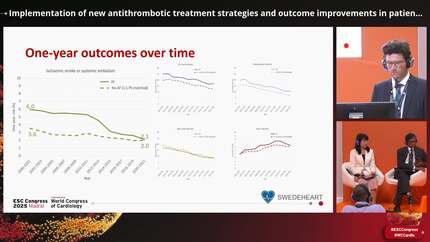
Nationwide data from SWEDEHEART and national health registries were used to identify 71 513 survivors of an acute MI with AF between 2000 and 2021. Changes in antithrombotic therapies over time in 2-year cohorts were analysed, and associations with 1-year outcomes were assessed. The outcomes were ischaemic stroke or systemic embolism, MI, major bleeding, CV mortality and all-cause mortality. Logistic regression was used to standardize for changes in patient characteristics and treatment over time. Oral anticoagulant use increased from 21% in 2000–2001 to 75% in 2020–2021, largely due to adoption of direct oral anticoagulants (DOACs) after the first DOAC approval in 2011, most often combined with a single antiplatelet. Over time, particularly in the last decade, 1-year risk of ischaemic stroke or systemic embolism declined from 6.0% to 2.1%, and CV mortality decreased from 19.8% to 10.5%. Major bleeding increased from 3.9% to 7.6% in 2014–2015, then declined to 6.4% in 2020–2021, simultaneously with adoption of single rather than dual antiplatelet therapy in combination with DOAC.
Between 2000 and 2021, among patients with MI and AF, we observed reductions in 1-year risks of ischaemic stroke or systemic embolism and CV mortality, occurring during a period of increased prescription of oral anticoagulants, particularly DOACs.
Key Question
Have recent clinical trial findings on antithrombotic therapy in patients with myocardial infarction and concomitant atrial fibrillation been implemented, and have they resulted in any improvement in 1-year outcomes?
Key Finding
In patients with myocardial infarction and atrial fibrillation, we observed substantial reductions in 1-year risks of ischaemic stroke or systemic embolism and cardiovascular mortality, associated with increased prescribing of oral anticoagulants, particularly DOACs.
Contributors


Lars Lindhagen
Author
Lars Wallentin
Author
Tomas Jernberg
Author
Joakim Alfredsson
Author

Gorav Batra
Author
You may be interested in