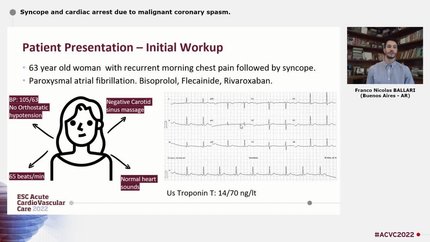
Clinical value of ST-segment change after return of spontaneous cardiac arrest and emergent coronary angiography in patients with out-of-hospital cardiac arrest: Diagnostic and therapeutic importance of vasospastic angina
European Heart Journal - Acute CardioVascular Care


Abstract
We investigated the association between initial ST-segment change after return of spontaneous circulation (ROSC) and the incidence of acute coronary lesions in patients with out-of-hospital cardiac arrest (OHCA), and clinical outcomes of patients with OHCA caused by vasospastic angina pectoris (VSA).
Among 2779 OHCA patients in our institution, all patients with ROSC underwent emergent coronary angiography (CAG) except for those with an obvious extra-cardiac cause of OHCA. Initial ST-segment changes after ROSC were reviewed, and 30-day survival and neurological outcome (Cerebral Performance Category) were evaluated.
Of the 155 patients, 52 (34%) had ST-segment elevation (STE) and 103 (66%) had non-STE. Significant coronary culprit lesions were present in 81% of patients with STE and in 33% of patients with non-STE (
An acute culprit lesion may be the cause of OHCA even in the absence of STE. In survivors of OHCA with normal coronary arteries, spasm provocation testing should be performed to detect VSA as a cause of the arrest.
Contributors

Kazuya Tateishi
Author
Tooru Iwama
Author
Yuichi Hamabe
Author
Kazutaka Aonuma
Author
Akira Sato
Author
You may be interested in