Oxygenation-sensitive cardiovascular magnetic resonance imaging to identify coronary microvascular and vasomotor dysfunction in angina and no obstructive coronary artery disease
European Heart Journal - Cardiovascular Imaging


Abstract
Endothelial-dependent coronary microvascular and vasomotor dysfunction (CMVD), which requires invasive coronary function test (ICFT) with intracoronary acetylcholine for diagnosis, is the predominant cause of angina in patients with no obstructive coronary artery disease (ANOCA). Oxygenation-sensitive cardiovascular magnetic resonance (OS-CMR) is a potential non-invasive, needle-free diagnostic test for endothelium-dependent CMVD. This study aimed to compare OS-CMR with vasoactive breathing manoeuvres with clinically performed, gold-standard ICFT in ANOCA patients with endothelial-dependent CMVD and healthy controls.
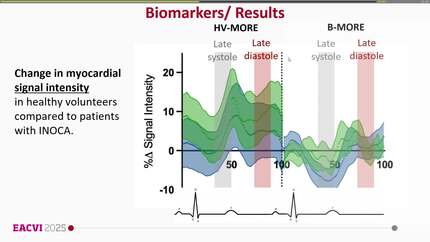
We conducted a prospective, single-centre study that enrolled 25 ANOCA patients diagnosed with endothelium-dependent CMVD by ICFT compared to 34 healthy participants. All participants underwent OS-CMR with vasoactive breathing manoeuvres—inducing vasoconstriction then vasodilation. OS-CMR-derived biomarkers including the hyperventilation-induced myocardial oxygenation response (HV-MORE), breath-hold induced MORE (BH-MORE), and mean signal intensity (MI) were measured within the peri-systolic and late-diastolic phases of the cardiac cycle due to their physiologic relevance. Logistic regression with absolute shrinkage and selection operator (LASSO) penalization identified promising predictive biomarkers of CMVD in ANOCA patients.
Compared to healthy participants, ANOCA-CMVD patients exhibited a significantly impaired oxygenation response to vasoactive breathing manoeuvres. Late-diastolic HV-MOREMI-VAR and peri-systolic BH-MOREMI-AUC emerged as potential predictors of endothelial-dependent CMVD. The LASSO-derived multivariate model, adjusting for age, demonstrated apparent discrimination (area under the curve 0.92), sensitivity (88.9%), specificity (82.1%), positive predictive value (82.8%), negative predictive value (88.5%), and accuracy (85.5%) in identifying endothelial-dependent CMVD in ANOCA patients.
In this small single-centre cohort, we demonstrated the potential of physiologic markers derived from OS-CMR with vasoactive breathing manoeuvres to differentiate ANOCA patients with ICFT confirmed endothelial-dependent CMVD from healthy controls. The clinical utility of this novel approach for non-invasively diagnosing CMVD needs further exploration with external validation in larger studies.
Contributors


Cassady Palmer
Author
Kate Lindsay
Author
Christian W Schmidt
Author
Daniela Valderrama Achury
Author
Judy Luu
Author
Danielle Tapp
Author
Namrita Ashokprabhu
Author
Andreas Tzoumas
Author
Ayushi Mohan
Author
Timothy D Henry
Author
Michael Nelson
Author
C Noel Bairey-Merz
Author
Wojciech Mazur
Author
Matthias G Friedrich
Author

You may be interested in