Ventricular fibrillation dynamics reveal regional asymmetry in resilience to cardiac arrest and predict clinical outcome
Cardiovascular Research


Abstract
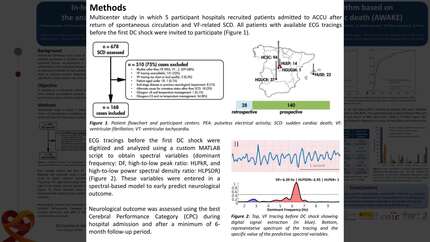
Ventricular fibrillation (VF) is the leading cause of sudden cardiac death. Nevertheless, the mechanisms underlying VF dynamics in structurally normal hearts and infarct-related substrates remain incompletely understood. We aimed to characterize the electrophysiological, structural and molecular properties that explain VF dynamics during early phases (seconds) and long-duration episodes (minutes) in experimental pig models. Additionally, we assessed the clinical impact of VF dynamics on neurological prognosis following resuscitated cardiac arrest.
A total of 72 pigs were included in the study.
VF dynamics are modulated by asymmetric myocardial tolerance to global ischaemia. Among patients admitted after a VF-related cardiac arrest event, higher ARs prior to the first defibrillation shock are predictive of a favourable neurological outcome.
Contributors

Laura Gil-Martínez
Author
Sergio Muñoz-Romero
Author
Carlos Galán-Arriola
Author
Javier Sánchez-González
Author
Juan José González-Ferrer
Author
Victoria Cañadas-Godoy
Author

Ricardo Salgado-Aranda
Author
Jorge G Quintanilla
Author
Alba Cruz-Galbán
Author
Álvaro Macías
Author
María Jesús García-Torrent
Author
José Luis Rojo-Álvarez
Author
Peter Lee
Author
Javier Saiz
Author
David Calvo
Author
Borja Ibañez
Author
Marinela Couselo-Seijas
Author
Manuel Marina-Breysse
Author
Ana Simón-Chica
Author
Julián Pérez-Villacastín
Author
Nicasio Pérez-Castellano
Author
José Jalife
Author
José M Ferrero
Author
Alba García-Escolano
Author

Alba Ramos-Prada
Author
José Manuel Alfonso-Almazán
Author
Jesús Diz-Díaz
Author
You may be interested in