First experience with a stylet-driven, fixed-helix lead designed for left bundle branch area pacing: the BIO-MASTER-CSP study
EP Europace Journal


Abstract
Left bundle branch area pacing (LBBAP) becomes widely adopted to provide physiologic ventricular pacing. It requires a pacing lead deployed deep in the interventricular septum. A new pacing lead was designed specifically for LBBAP.
This report summarizes acute and early post-operative clinical performance until one month after implantation.
The Solia CSP S pacing lead is designed and approved exclusively for LBBAP. It is implanted with both guiding catheter and stylet support. It has a non-retractable helix to reduce elasticity during the screwing. The helix is longer and has a wider pitch than traditional pacing leads. The BIO|MASTER-CSP study is a single-arm, multicentric, international study to evaluate the clinical performance and safety of the lead in patients with an indication for bradycardia or cardiac resynchronization therapy. Patients are followed for one year; this interim report was triggered by the completion of all implantations.
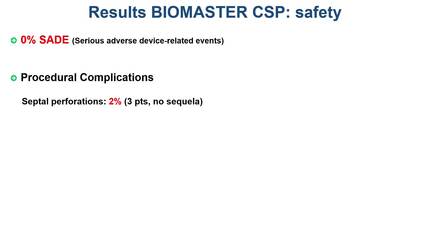
Of 155 patients (29% female, 76 ± 11 years), 15% had a cardiac resynchronization indication. Acute LBBAP implantation success was 151/155 (97.4%) with confirmed conduction system pacing (CSP) in 81.3% and left ventricular septal pacing (LVSP) in the remaining 18.7% of patients with LBBAP implantation. In 43% of the cases, the lead was implanted in the first position; the median number of screw attempts was 2 (IQR 1-3) per patient. Mean procedural time measured 56 ± 23 minutes and fluoroscopy duration was 9 ± 7 minutes. Procedure related complications occurred in 3 (1.9%), all of them being septal perforations although without clinical consequences. Helix damage resulting in lead disuse occurred in 5 (3.2%) patients. Paced QRS duration measured 127 ± 24 ms. Sensing amplitudes (8.7 +/- 4.0 mV), pacing thresholds (0.95 +/- 0.53 V) and impedance (649 +/- 91 Ohm) were favourable and remained stable at 1 month follow. One lead dislocated before hospital discharge. At discharge and at 1 month, 97.6 and 95.2% of those with LBBAP at implantation had LBBAP maintained (EHRA criteria). Lead handing was judged advantageous when compared to established leads by 11 of 12 implanters (92%).
A novel stylet-driven, fixed helix lead, designed for LBBAP, yields high LBBAP implantation success, favourable intraprocedural safety and stable capture at the left bundle branch area.
Contributors

J De Pooter
Author
D Lau
Author
D Munawar
Author
J B Le Polain De Waroux
Author
S Healy
Author
M O'connor
Author
M Strik
Author
A Wauters
Author
N Rademakers
Author

L Loumaye
Author
J Bertrand
Author

You may be interested in