Electrical evolution after LBBAP: clinical, echocardiographic and procedural predictors of mid-term changes
EP Europace Journal


Abstract
Physiologic pacing is safe and feasible, but whether electrical synchrony persists at follow-up in patients undergoing left bundle branch area pacing (LBBAP), and which factors determine its evolution, remains incompletely understood.
To assess the performance of electrical synchrony at follow-up in patients treated with LBBAP for bradycardia and to identify independent clinical, echocardiographic, electrical, and procedural predictors of mid- to long-term changes in key electrical parameters.
Consecutive patients with successful LBBAP for bradycardia and preserved left ventricular ejection fraction were included. Twelve-lead ECGs during ventricular pacing at implant and follow-up were compared. Changes (Δ = implant – follow-up) were calculated for the main LBBAP electrical parameters. Univariate and multivariate linear regression analyses were performed to identify predictors of electrical evolution. Variables with p<0.10 in univariate analyses were entered into multivariate models. Models were adjusted for LBBAP characteristics at implant, including pacing subtype (LBBP vs LVSP), presence and timing of transition phenomena, and detection of left bundle branch (LB) potential.
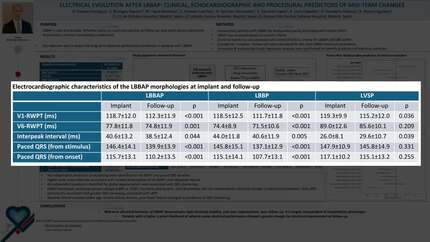
A total of 149 patients were studied. After 18.2 ± 7.3 months, V6-RWPT decreased from 77.8 ± 11.8 ms at implant to 74.8 ± 11.9 ms at follow-up (P<0.001), and V1-RWPT decreased from 118.7 ± 12.1 ms to 112.4 ± 11.9 ms (P<0.001). Inter-peak interval decreased from 40.6 ± 13.2 ms to 38.5 ± 12.4 ms (P=0.044). QRS duration shortened both when measured from pacing spike (146.4 ± 14.1 to 139.9 ± 13.9 ms, P<0.001) and from onset (115.7 ± 13.1 to 110.2 ± 13.5 ms, P<0.001).
In multivariate analysis (Table 1, Figure 1), several independent predictors emerged. Higher body mass index consistently predicted the prolonation of V1-RWPT and inter-peak interval, whereas longer paced QRS duration at implant predicted their shortening. No independent predictors were identified for changes in V6-RWPT. For global ventricular depolarization (QRS duration), chronic kidney disease, larger left atrial volume, older age, and septal perforation during implantation predicted QRS narrowing at follow-up. Importantly, LBBAP subtype (LBBP vs LVSP), capture-transition phenotype, and the presence of LB potential did not independently influence electrical evolution. Only left bundle trunk pacing morphology performed better than left fascicular pacing in predicting QRS improvement.
Mid-term electrical performance after LBBAP remains globally stable, with mild improvement across electrical parameters. Electrical changes were modest and determined by a combination of baseline clinical, electrical, and procedural factors. Crucially, LBBAP subtype and transition-related phenomena were not independent determinants of electrical evolution, supporting the robustness and durability of conduction-system pacing across implantation variants. Multivariate analysis Forest-plot
Contributors


S Briongos Figuero
Author
Public Company Hospital de Vallecas - Hospital Infanta Leonor Madrid , Spain

M Tapia Martinez
Author
E Sanchez Lopez
Author
A Luna Cabadas
Author
D Heredero Palomo
Author
You may be interested in