Long-term electrical performance of leadless pacemakers in dialysis patients: a single-center cohort study
EP Europace Journal


Abstract
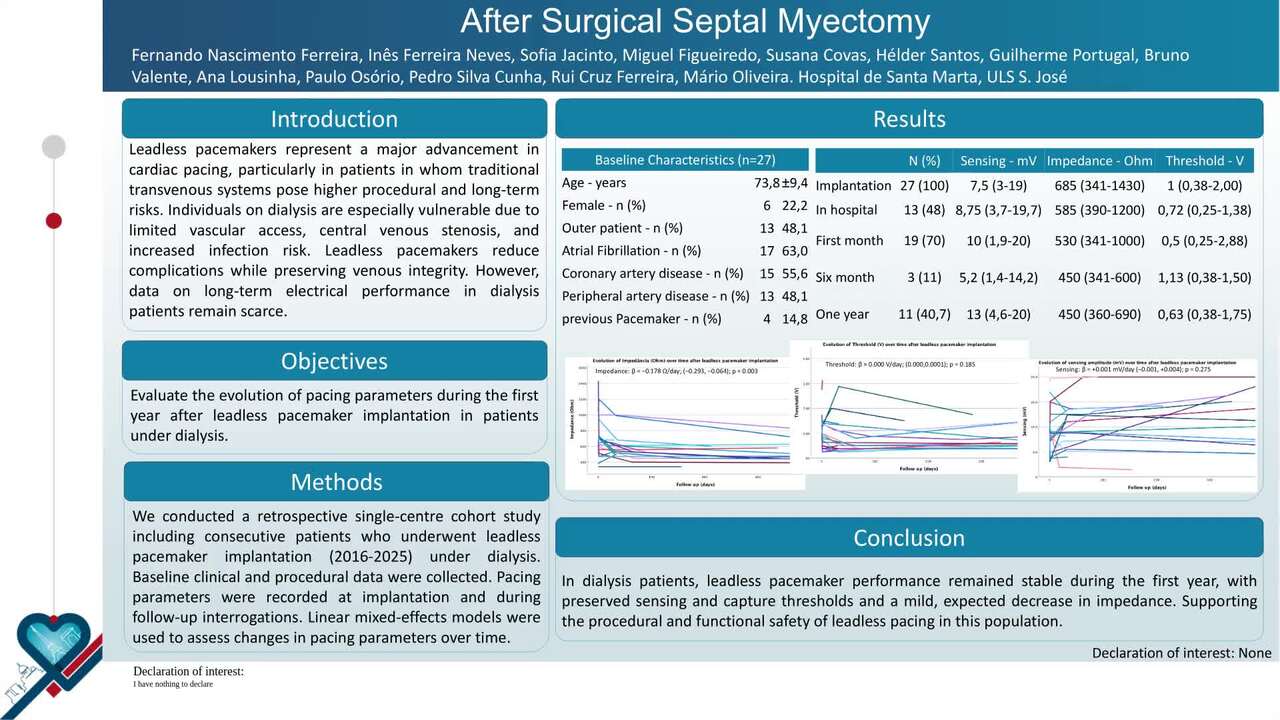
Leadless pacemakers represent a major advancement in cardiac pacing, particularly for patients in whom traditional transvenous systems pose higher procedural and long-term risks. Individuals with end-stage renal disease (ESRD) on dialysis are especially vulnerable due to limited vascular access, central venous stenosis, and increased infection risk. By eliminating transvenous leads and subcutaneous pockets, leadless pacemakers reduce these complications while preserving venous integrity. However, data on their long-term electrical performance in dialysis patients remain scarce. Evaluating the evolution of pacing parameters—sensing amplitude, impedance, and capture threshold—is essential to confirm their reliability in this high-risk group.
Evaluate the evolution of pacing parameters during the first year after leadless pacemaker implantation in patients under dialysis.
We conducted a retrospective single-centre cohort study including consecutive patients who underwent leadless pacemaker implantation between January and October 2025 under dialysis. Baseline clinical and procedural data were collected. Pacing parameters (sensing amplitude, impedance, and capture threshold) were recorded at implantation and during follow-up interrogations. Linear mixed-effects models were used to assess changes in pacing parameters over time.
A total of 27 patients (mean age 73.8 ± 9.4 years, 22% female) were included. The majority (63%) had atrial fibrillation. Implantation was most frequently in the mid-septum (56%) using Micra VR (63%). At implantation, mean sensing was 7,5 mV (range 3,0–19,0), impedance 685 Ω (341–1430), and threshold 1.00 V @ 0.24 ms (0.38–2.00).During follow-up (median 289 days, range 1–2533), mixed-effects analysis showed no significant change in sensing (β = +0.001 mV/day; 95% CI −0.001 to +0.004; p = 0.36) and in capture threshold (β ≈ 0.000 V/day; 95% CI 0.000–0.0001; p = 0.23). Conversely, impedance decreased significantly over time (β = −0.141 Ω/day; 95% CI −0.254 to −0.028; p = 0.016), corresponding to approximately −4 Ω per month.
In dialysis patients, leadless pacemaker performance remained stable during the first year of follow-up, with preserved sensing and capture thresholds and a mild, expected decrease in impedance. These findings support the procedural and functional safety of leadless pacing in this high-risk population, although larger studies with longer follow-up are warranted to confirm long-term device stability and performance.
Contributors

I Ferreira Neves
Author
S Jacinto
Author
M Figueiredo
Author
S Covas
Author
H Santos
Author
G Portugal
Author
B Valente
Author
A Lousinha
Author
P Osorio
Author
P Silva Cunha
Author
R Cruz Ferreira
Author
M Oliveira
Author
You may be interested in