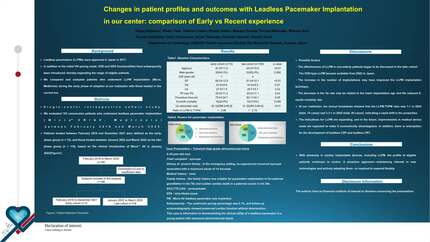
Changes in patient profiles and outcomes with leadless pacemaker implantation in our center: comparison of early vs recent experience
EP Europace Journal


Abstract
Leadless pacemakers (LLPM) obtained regulatory approval in Japan in 2017. Initially used in a limited population (VVI-only), more recent devices with VDD/DDD functionality have widened the indication. We examined the change in patient background and outcomes for LLPM implantation in our institution over time.
To compare patient characteristics and mid-term outcomes of LLPM recipients in our institution in the early-introduction phase versus the current phase.
Between February 2018 and March 2025, 174 patients underwent LLPM implantation at our center. We divided them into an early cohort (February 2018–December 2021; n = 72) and a recent cohort (January 2022–March 2025; n = 100). We compared baseline age, indication for implantation, procedure time, and six-month post-implant mortality between groups.
Mean age was significantly higher in the early cohort (87.8 ± 11.5 years) than in the recent cohort (84.2 ± 10.0 years; p = 0.034). The implantation indications were: atrial fibrillation with bradycardia in 23 patients (32 %) in the early cohort vs 19 patients (19 %) in the recent cohort; atrioventricular (AV) block in 33 (46 %) vs 55 (55 %); sick sinus syndrome in 29 (40 %) vs 37 (37 %) respectively. Procedure time was 75.6 ± 24.7 minutes in the early cohort vs 80.1 ± 24.1 minutes in the recent cohort (p = 0.28). Six-month mortality after implantation was 16 in the early cohort vs 10 in the recent cohort (odds ratio 2.75; 95 % CI, 1.09–6.06; p = 0.046). Implantation in patients aged ≤ 60 was rare (early 1 patient; recent 3 patients).
In our center, LLPM implantation in the early phase was performed in an older patient population, whereas in the recent phase there has been a shift toward increased use for AV block and broader patient profiles. This change may reflect growing evidence for the efficacy of LLPM in less advanced age groups and the availability of VDD-capable LLPM since 2022. As pacing device technology continues to evolve, the eligible patient population will keep changing — proactive engagement with new technologies remains essential for optimal patient care.
Contributors

K Yabe
Author
T Katou
Author
M Yuzawa
Author
R Saitou
Author
H Watanabe
Author
M Itou
Author
Y Samejima
Author
T Hukuyama
Author
Y Kameda
Author
S Yamazaki
Author
H Takenaka
Author
N Nemoto
Author
H Anzai
Author
You may be interested in