Transseptal access with an electrified guidewire and large pulsed field ablation sheath
EP Europace Journal


Abstract
Transseptal puncture (TSP) with application of electrocautery to a guidewire has not been described directly via a large, pulsed field ablation (PFA) sheath to facilitate left atrial (LA) access.
: To describe and characterize the efficacy and safety of our electrified 0.035" guidewire TSP (ETSP) technique via a 17Fr Faradrive PFA sheath.
We analyzed success, TSP time (from groin puncture to first LA electrogram), and complications of ETSP with a standard 0.035" Rosen guidewire directly via a Faradrive sheath. These were compared to patients undergoing left atrial ablation via: 1) traditional TSP with a Swartz Left (SL) sheath/BRK needle (non-ETSP) for Farapulse PFA; and 2) ETSP with smaller, non-Faradrive sheaths for radiofrequency ablation (RFA).
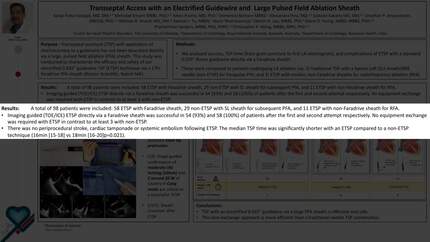
A total of 98 patients were included: 58 ETSP with Faradrive sheath, 29 non-ETSP with SL sheath for subsequent PFA, and 11 ETSP with non-Faradrive sheath for RFA. ETSP directly via a Faradrive sheath was successful in 54 (93%) and 58 (100%) of patients after the first and second attempt respectively. No equipment exchange was required with ETSP in contrast to at least 3 with non-ETSP. There was no periprocedural stroke, cardiac tamponade or systemic embolism following ETSP. The median TSP time was significantly shorter with an ETSP compared to a non-ETSP technique (16min [15-18] vs 18min [16-20]p=0.024).
TSP with an electrified 0.035" guidewire via a large PFA sheath is effective and safe. This zero-exchange approach is more efficient than a traditional needle TSP combination. Graphical abstract Procedural workflow: ETSP technique
Contributors



B Domenico
Author
A Pina
Author
S Kakarla
Author
J Ariyaratnam
Author
A Anand
Author
S Tu
Author
N Weerasooriya
Author
D Lau
Author
G Young
Author
K Roberts-Thomson
Author

You may be interested in