Novel mapping-integrated pulsed-field ablation technology for pulmonary vein isolation in patients with atrial fibrillation: learning curve, efficiency, and safety
EP Europace Journal


Abstract
Real-world evidence assessing the learning curve and procedural efficiency of the pentaspline pulsed-field ablation (PFA) system with novel mapping-integrated capabilities remains limited.
To evaluate the learning curve associated with mapping-integrated PFA technology and to assess its impact on procedural efficiency and acute procedural outcomes in pulmonary vein isolation (PVI).
This multicenter observational study included all consecutive patients undergoing atrial fibrillation (AF) ablation using Farapulse PFA integrated with a novel mapping system (Faraview) across 18 centers. Only patients undergoing their first PVI procedure were analyzed; cases involving additional ablation targets were excluded. Procedural parameters were analyzed in relation to operator experience. Operators were asked to predefine their ablation strategy before each case and to document any deviations from the planned approach and the rationale for these modifications. Data are presented as median [interquartile range].
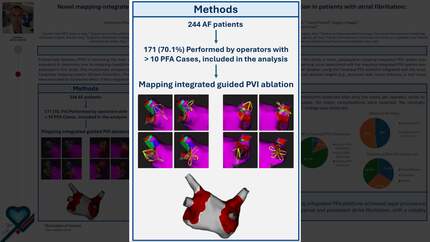
A total of 244 patients were included (paroxysmal AF: 88.1%). Of these, 171 (70.1%) procedures were performed by operators with prior experience of >10 PFA cases and were included in the learning curve analysis. Total cath lab utilization, skin-to-skin, and fluoroscopy times were 100[80–120] min, 60[50–75] min, and 12[8–17]min, respectively. Acute PVI was achieved in 100% of patients, with a median of 44[38–54] PFA applications. The learning curve was steep, with significant improvements observed after only five cases per operator, while no further improvement was detected beyond ten cases: cath lab utilization: 110[90–150] min (first 5 cases) vs. 95[70–120] min (after first 5 cases), p=0.011; skin-to-skin time: 75[65–95] min vs. 60[50–70] min, p=0.001, fluoroscopy time: 16[11–19] min vs. 11[8–16] min, p=0.009. No differences were found in the number of PFA deliveries (42[38–54] vs. 44[38–54], p=0.876). The actual number of PFA deliveries was higher than initially planned (32[32–40] vs. 44[38–54]; p<0.001; difference: 6[2–13]). In 8.2% of cases, fewer deliveries were performed than planned; in 11.1%, the number matched the plan; and in 80.7%, more deliveries were delivered than initially intended. A standard PVI strategy was used in 82 cases (48.0%), while 69 cases (52.0%) included an additional peri-PV lesion set: consolidative in 28 (31.5%), extensive in 24 (27.0%), and mixed in 31 (34.8%) procedures. No major complications were reported. No clinically relevant hemolysis, stroke, pericarditis or acute ST-T change was observed.
In this first multicenter real-world experience, the pentaspline mapping-integrated PFA system demonstrated high procedural efficiency, safety, and acute effectiveness in both paroxysmal and persistent AF patients. The learning curve was remarkably short, with significant improvements in procedural metrics observed after only a few cases.
Contributors




You may be interested in