Anemia and renal dysfunction predict early major bleeding over stroke in atrial fibrillation with acute heart failure
EP Europace Journal


Abstract
Anticoagulation after acute heart failure (AHF) with atrial fibrillation (AF) is difficult because early post-discharge trajectories diverge among major bleeding, ischaemic stroke, and death. Clinicians need a simple, safety-first signal to anticipate which event tends to occur first and to tailor oral anticoagulation (OAC) intensity accordingly.
(i) To compare the first occurrence of major bleeding versus ischaemic stroke under a competing-risk framework; (ii) to determine whether the composite of anaemia and renal dysfunction (AR-high: haemoglobin <12 g/dL plus creatinine clearance <50 mL/min) identifies patients in whom bleeding precedes stroke; and (iii) to evaluate one-year discrimination and calibration of pragmatic models that add AR-high to standard scores.
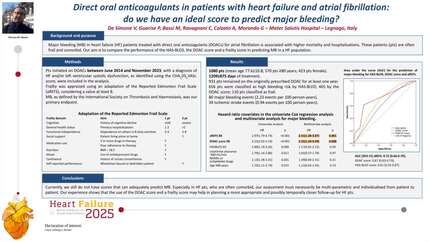
First events were bleeding in 81 patients (11%), stroke in 39 (5%), and death without prior stroke/bleeding in 140 (20%). In multivariable FGR, HAS-BLED (per point, sHR 1.26, p=0.009) and AR-high (sHR 1.84, p=0.013) independently predicted bleeding-first; no baseline variable reliably predicted stroke-first. One-year bleeding incidence was 15.5% in AR-high vs 5.0% in AR-low (Gray p<0.001). Adding AR-high to HAS-BLED improved 1-year discrimination AUC 0.612 → 0.701 (p=0.009) and IDI +0.146, with preserved monotonic calibration across deciles. In patients discharged on OAC, AR-high remained significant (sHR 4.14, p<0.001). Findings were concordant at three years and stable across sensitivity thresholds.
In contemporary AHF with AF, bleeding tends to occur before stroke, and this tendency is sharply accentuated by AR-high on top of HAS-BLED. A first-event, competing-risk perspective—validated by one-year AUC and decile calibration—directly informs safety-first decisions: intensify bleed-mitigation and consider OAC de-escalation or non-pharmacological strategies in AR-high patients, while maintaining stroke prevention where thromboembolic risk dominates and bleeding risk is acceptable. Predictors of first major bleeding Decile-based calibration plot
Contributors

K Nakamura
Author
Y Enomoto
Author
H Hayama
Author
H Yokomori
Author
Y Tsukagoshi
Author
T Shimizu
Author
M Asami
Author
N Sahara
Author
M Yamamoto
Author
H Hara
Author
H Hara
Author
Y Hiroi
Author
You may be interested in