Atrial fibrillation burden according to genetic risk: a secondary analysis of the randomised LOOP study
EP Europace Journal


Abstract
Polygenic risk scores (PRSs) for atrial fibrillation (AF) are well-established, but how genetic risk influences AF burden remains unclear.
This study aimed to investigate the association between a PRS for AF and AF burden and the occurrence of long-lasting AF episodes using continuous monitoring data from individuals with implantable loop recorders (ILR).
The LOOP study (Atrial Fibrillation Detected by Continuous ECG Monitoring Using Implantable Loop Recorder to Prevent Stroke in High-Risk Individuals) randomised 6,004 individuals aged 70 years or older without AF but with risk factors for AF and stroke to either screening with ILR or usual care. ILR-detected AF diagnosis was adjudicated by senior cardiologists.
This post-hoc analysis included participants randomised to ILR with available genetic data. Genetic predisposition to AF was assessed by a PRS based on previously published and validated weights (AF-PRS). AF burden was calculated as the cumulative duration of all AF episodes lasting ≥6 minutes and occurring after the first adjudicated AF episode, divided by the total time of ILR monitoring, while the occurrence of long-lasting AF episodes was defined as at least one episode ≥24h. Associations between AF-PRS and AF burden and long-lasting AF were assessed per standard deviation (SD) increase in AF-PRS in linear and logistic regression models. AF burden was log-transformed prior to analysis in the linear model. In secondary analyses, AF burden was categorised as 0%, <0.05%, 0.05–0.5%, 0.5–5%, or >5%. All models were adjusted for sex, age, baseline thyroid-stimulating hormone, genetic principal components 1–10 (accounting for population stratification), and comorbidities (hypertension, diabetes, valvular disease, heart failure, and acute myocardial infarction).
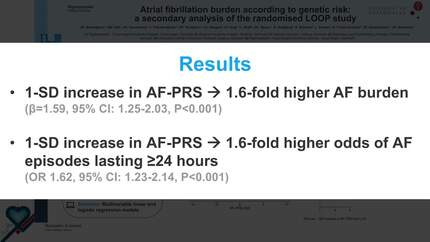
A total of 1,340 individuals were included (89% of all randomised to ILR) with 1,556,192 days of continuous cardiac monitoring. Median age was 73.1 years and 46% were women. Adjudicated AF occurred in 444 individuals with a mean arrhythmia burden of 3.03%. A 1-SD increase in AF-PRS was associated with a higher AF burden in the linear model (β=1.59, 95% confidence intervals [CI]: 1.25-2.03, P<0.001) and with higher occurrence of 24h episodes (odds ratio (OR)=1.62, 95% CI: 1.23-2.14, P<0.001). Compared with participants with no detected AF, a 1-SD increase in AF-PRS was associated with higher OR for being in a higher burden category, with the highest OR observed for the >5% burden category (OR=2.28, 95% CI: 1.63-3.18, P<0.001).
Across more than 1.5 million days of continuous cardiac monitoring, an AF-PRS was associated with higher AF burden and long-lasting episodes. These exploratory findings suggest that genetic risk could potentially help identify individuals at risk of more sustained forms of AF, allowing for more individualised disease management.
Contributors




You may be interested in