An Artificial Intelligence based model for predicting long-term all-cause mortality after acute Myocardial Infarction (the AIMI model)
European Heart Journal - Digital Health


Abstract
Predicting long-term mortality after acute myocardial infarction (AMI) remains challenging. We aimed to establish an Artificial Intelligence—based model for predicting long-term all-cause mortality after AMI (the AIMI model).
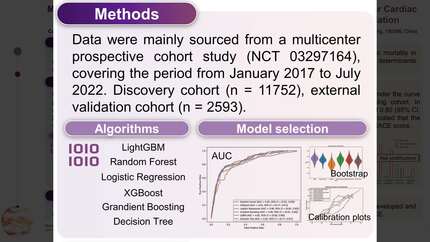
AIMI model was employed by RF (Random forest). Individual predictions were visualized by SHAP plots. AIMI model was compared against existing clinical risk scores using time-dependent ROC (receiver operating characteristic) curves, and Kaplan-Meier (K-M) analyses. External validation was also performed at the same way. Brier scores were calculated in validation cohorts. We consecutively enrolled 4825 AMI patients underwent emergent coronary angiography or PCI procedures within 24 h of symptom onset to train and test the AIMI model and 723 AMI patients for external validation. Model incorporated 15 variables achieved robust performance (C-index = 0.81). As indicated by AUCs in the test set, AIMI model outperformed GRACE and TIMI risk scores across short-, mid- and long-term periods, especially for long-term prediction (1, 3 and 5 years). K-M curves confirmed precise discrimination between low-, median-, and high-risk groups (all
The AIMI model surpassed traditional methods for long-term all-cause death prediction after AMI. AI-based model demonstrated potential to enhance risk stratification and guide post-discharge management.
Contributors

Linghan Xue
Author
Wenmiao Wang
Author
Qianli Zhao
Author
Wentao Li
Author
Wenhao Dong
Author
Shaodi Yan
Author
Xiaoxiao Zhao
Author
Jiannan Li
Author
Runzhen Chen
Author
Nan Li
Author
Shuai He
Author
Chen Liu
Author
Peng Zhou
Author
Yi Chen
Author
Li Song
Author
Hongbing Yan
Author
Zhi Liu
Author
Hanjun Zhao
Author
You may be interested in