Shared splicing dysregulation in heart failure associated with dilated and ischaemic cardiomyopathy and spatial specificity across cardiac regions
Cardiovascular Research


Abstract
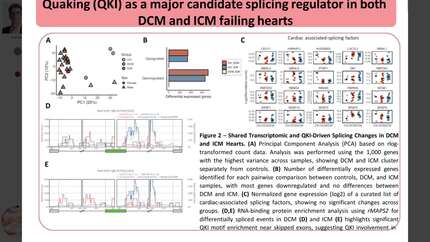
Alternative splicing plays a critical role in cardiac development and function and becomes dysregulated in heart failure. Although splicing defects have been described in both dilated (DCM) and ischaemic (ICM) cardiomyopathy, the extent to which these alterations contribute to disease mechanisms and how they are spatially distributed across cardiac regions remains poorly understood. This study aimed to profile alternative splicing events across the left ventricle (LV), right ventricle (RV), and interventricular septum (IVS) in end-stage heart failure patients with DCM and ICM, and to investigate potential regulatory factors driving these changes.
RNA-seq was performed on LV tissue from patients with DCM (
This study presents the first multi-chamber analysis of splicing in human heart failure, revealing a set of splicing events commonly dysregulated in DCM and ICM. These findings support the notion that splicing dysregulation can be a shared molecular response to advanced cardiac remodelling, rather than a driver of aetiology-specific pathology. We further uncovered distinct spatial patterns: in DCM, splicing alterations were consistently observed across all cardiac chambers, likely reflecting diffuse myocardial involvement. In contrast, certain splicing changes in ICM were restricted to the LV, consistent with the focal nature of ischaemic injury.
Contributors

Marta Furtado
Author
Pedro Barbosa
Author
Ana Wemans
Author
Lu Zhang
Author
Andrew Lumley
Author
Teresa Carvalho
Author
Patrícia Napoleão
Author
Przemyslaw Leszek
Author
Maria Carmo-Fonseca
Author

You may be interested in