Lipoprotein(a) selectively associates with vulnerable coronary plaque phenotypes in comparison with other established risk markers
European Heart Journal - Cardiovascular Imaging


Abstract
Lipoprotein(a) [Lp(a)] is an inherited cardiovascular risk factor. However, its association with coronary plaque characteristics beyond traditional risk enhancers remains unclear. We aimed to evaluate the association between Lp(a) levels and coronary plaque characteristics in asymptomatic primary prevention patients, and to compare its predictive value against other risk enhancers, including LDL particle concentration (LDL-P), high-sensitivity C-reactive protein (hsCRP), and coronary artery calcium (CAC) score.
We retrospectively analysed 547 asymptomatic patients undergoing coronary computed tomography angiography (CCTA) between 2018 and 2024. Plaque characteristics were assessed using artificial intelligence-based quantitative CCTA. Associations between Lp(a), LDL-P, hsCRP, CAC score, and plaque features were evaluated using multivariable regression adjusted for age and sex. Median age was 56 years, 69.8% were male. Higher Lp(a) was associated with greater total plaque volume (β=23.1 mm³,
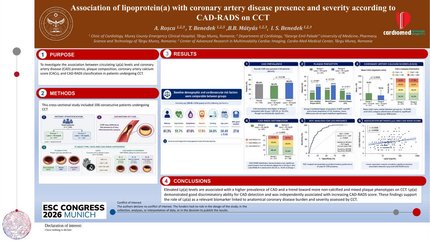
In asymptomatic primary prevention patients, Lp(a) was independently associated with high-risk coronary plaque features, specifically LDNCP, beyond traditional risk enhancers. These findings highlight the unique role of Lp(a) in identifying coronary plaque vulnerability and suggest complementary roles for Lp(a) and CAC in refining cardiovascular risk stratification.
Contributors

Rebecca Fisher
Author

Edward A Fisher
Author
Jisuk Park
Author
Melissa Aquino
Author
Sascha N Goonewardena
Author
Robert S Rosenson
Author
Icahn School of Medicine at Mount Sinai New York City , United States of America
You may be interested in