Accuracy of non-invasive electrocardiographic imaging in scar-dependent ventricular tachycardia: relationship to arrhythmogenic substrate and imaging defined scar
EP Europace Journal


Abstract
Accuracy data for non-invasive electrocardiographic imaging (ECGi) in defining the arrhythmogenic substrate for scar-dependent ventricular tachycardia (VT) is lacking. This study evaluated the accuracy of ECGi mapping to localize the arrhythmogenic substrate and assessed the relationship to myocardial scar, isthmus, exit, and successful ablation sites.
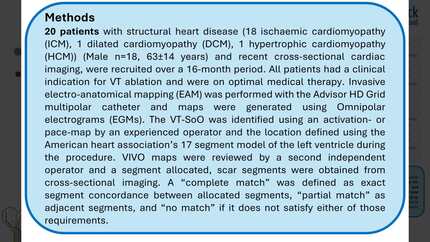
A total of 48 VTs in 31 patients were mapped with both ECGi (View into Ventricular Onset, VIVO) and electro-anatomical maps (EAM) to define the arrhythmogenic substrate. Myocardial segments were assigned for the VT-exit site region (VT-ESR), isthmus region, successful ablation sites, and cardiac cross-sectional imaging defined scar using the ventricular AHA segment model and underwent blinded analysis.
VT-ESR complete match (defined as exact AHA segment concordance between ECGi and EAM) was seen in 67% and partial match (defined as adjacent segments) in 21% of VTs. ECGi VT-ESR was located within or adjacent to cross-sectional imaging defined scar in 85% of VTs. The VT isthmus was within or adjacent to the ECGi VT-ESR in 77% of VTs. Successful ablation sites were within or adjacent to the ECGi VT-ESR in 82% of VTs. VIVO ECGi accuracy was not affected by cardiomyopathy type or VT cycle length. In identifying epicardial VT-ESR for ischaemic cardiomyopathy, VIVO ECGi had a sensitivity and specificity of 71.4% and 92.9%; for non-ischaemic cardiomyopathy 66.7% and 100%, respectively.
ECGi mapping with VIVO can accurately predict the arrhythmogenic substrate for scar-dependent VT. Incorporation of ECGi mapping to conventional VT ablation workflows may improve procedural efficiency.
Contributors

Jaffar Al-Sheikhli
Author
Xuezhe Wang
Author
University of Warwick Coventry , United Kingdom of Great Britain & Northern Ireland
Joseph Mayer
Author
Mohamed Anwar Mohamed
Author
Syed Rizwan Ali
Author
Rafaella Siang
Author
University Hospitals of Coventry and Warwickshire NHS Trust Coventry , United Kingdom of Great Britain & Northern Ireland
May Thant
Author
Ian Patchett
Author

Ahmed Ammar
Author
Worcerstershire Acute Hospitals NHS Trust Worcester , United Kingdom of Great Britain & Northern Ireland
John Silberbauer
Author
Christopher O’Shea
Author
Fayyaz Minhas
Author

Jamal Nasir
Author
University Hospitals of Coventry and Warwickshire NHS Trust Coventry , United Kingdom of Great Britain & Northern Ireland

Tarvinder Dhanjal
Author
University Hospitals of Coventry and Warwickshire NHS Trust Coventry , United Kingdom of Great Britain & Northern Ireland
You may be interested in