Impact of sex on residual angina after percutaneous coronary interventions
European Heart Journal Supplements


Abstract
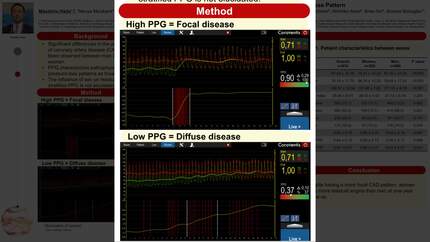
Significant differences in the presentation of coronary artery disease (CAD) have been observed between women and men. The pullback pressure gradient (PPG) quantifies pathophysiological CAD patterns as focal or diffuse.
This study investigated the influence of sex on residual angina stratified by PPG after percutaneous coronary intervention (PCI).
We performed a sub-analysis of the PPG Global, a multicenter, prospective, single-arm study. All patients had hemodynamically significant CAD (fractional flow reserve [FFR] ≤ 0.80) and underwent a manual FFR pullback to calculate PPG before PCI. Patient-reported outcomes were collected using the 7-item Seattle Angina Questionnaire (SAQ-7) at baseline and one-year follow-up.
We included 814 patients (205 [25.2%] women and 609 [74.8%] men). Women were significantly older than men (70.2±10.2 years vs 67.2±10.0 years p< 0.001). Baseline FFR were comparable between sexes (0.68±0.13 vs. 0.66±0.12, p=0.098) but women had a more focal CAD compared to men (PPG 0.66 ± 0.15 vs. 0.63 ± 0.15, p=0.047). Post PCI-FFR was higher in women than men (0.88 ± 0.07 vs. 0.87 ± 0.07, p=0.041); however, angina at one year was more frequent in women (SAQ angina frequency score 94.4 ± 12.4 vs 96.1 ± 9.6, p=0.041).
Despite having a more focal CAD pattern and achieving higher post-PCI FFR, women report more residual angina than men at one-year follow-up. Graphical abstract SAQ-7 at 12 month - Men vs. Women
Contributors


M Hada
Author
T Mizukami
Author
K Ikeda
Author
S Brouwers
Author

N Stalikas
Author
J Sonck
Author

T Shinke
Author

C Collet
Author
New York Presbyterian Hospital Of Columbia And Cornell New York , United States of America
You may be interested in