Left main bifurcation and trifurcation PCI: patient characteristics, procedural complexity and outcomes from a multicentre all-comers registry
European Heart Journal Supplements


Abstract
Left main (LM) bifurcation lesions represent one of the most technically demanding and prognostically significant subsets in interventional cardiology. When a second side branch is involved, forming a true trifurcation, anatomical and procedural complexity markedly increase. Despite advances in stent technology and intravascular imaging, evidence on long-term clinical outcomes after LM trifurcation PCI remains scarce.
To compare procedural characteristics and long-term outcomes following percutaneous coronary intervention (PCI) for LM bifurcation and trifurcation lesions in a contemporary multicentre registry.
This retrospective, binational, observational study included all consecutive patients undergoing LM bifurcation or trifurcation PCI between July 2011 and December 2022 at two European tertiary centres. The primary endpoint was major adverse cardiovascular events (MACE), defined as a composite of all-cause death, acute coronary syndrome (ACS), and target bifurcation revascularisation (TBR). Secondary endpoints were the individual components of MACE. Multivariable Cox regression and propensity-score matching (PSM, 3:1) were used to adjust for baseline and clinical differences.
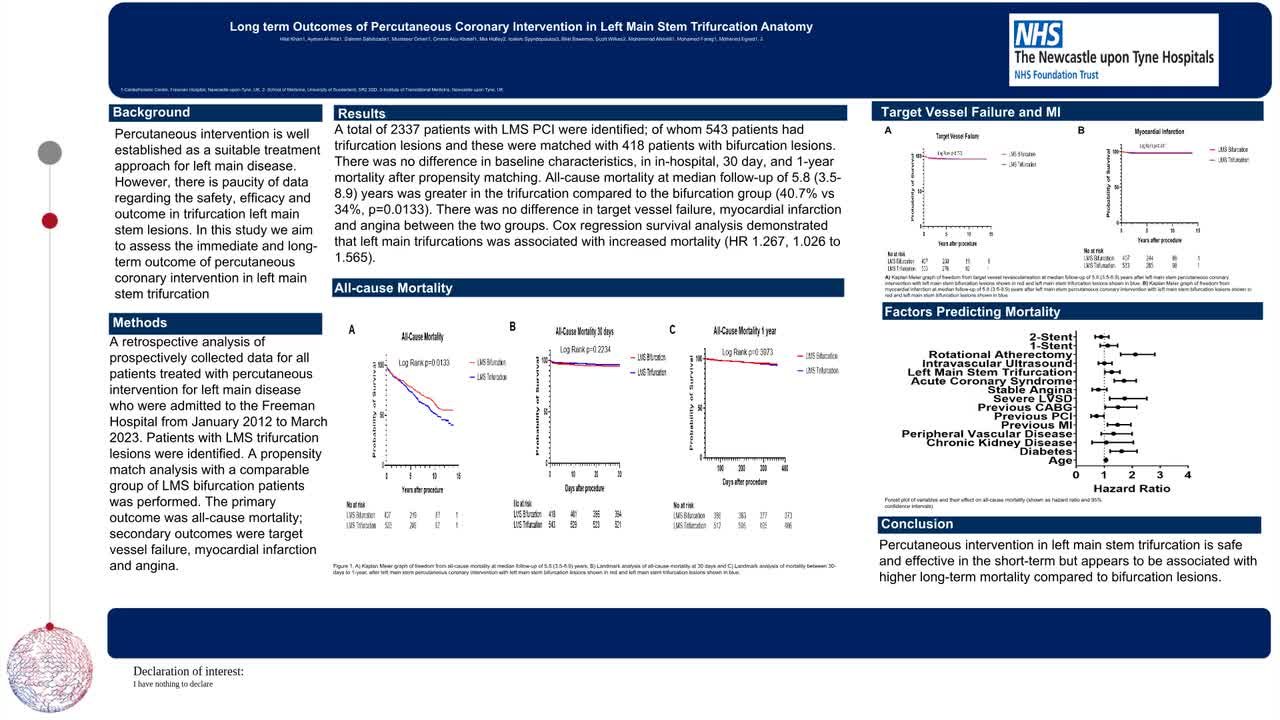
Overall, 1 066 LM PCI procedures were analysed, including 923 (86.6%) bifurcations and 143 (13.4%) trifurcations. Procedural success exceeded 98% in both groups. Kaplan–Meier analysis (Figure 1) demonstrated a higher cumulative incidence of MACE in LM trifurcation compared with bifurcation PCI. At a median follow-up of 39 months (IQR 15–64), MACE occurred in 40.4% vs 26.5% (p = 0.001). The difference was significant for all individual components: all-cause death (21.8% vs 7.8%; p = 0.025), ACS (14.4% vs 5.5%; p = 0.003), and TBR (9.2% vs 6.5%; p = 0.001). Trifurcation anatomy independently predicted MACE (HR 1.6, 95% CI 1.2–2.1; p = 0.001), consistent after multivariable adjustment and PSM. Within the trifurcation subgroup, at multivariable analysis (Figure 2), the only two independent predictors of MACE were serum creatinine and the Modified Medina LM Trifurcation Score, which integrates lesion distribution and longitudinal extension by coding disease across the LM, LAD, LCx, and RI segments and adding points for side-branch lesions ≥5 mm, yielding a 1–6 scale of anatomical complexity.
LM trifurcation anatomy is associated with substantially worse long-term outcomes after PCI compared with LM bifurcations, even after comprehensive statistical adjustment and matching. The Modified Medina LM Trifurcation Score effectively stratifies risk among trifurcations, identifying patients who may benefit from systematic intravascular imaging, optimised techniques, and meticulous long-term follow-up. These findings highlight the need for tailored procedural planning and prospective evaluation of LM trifurcation PCI strategies.
Contributors





You may be interested in