Novel leaflet modification with balloon-assisted translocation of the anterior mitral leaflet facilitates transcatheter mitral valve replacement in prohibitive anatomies: a case series
European Heart Journal Supplements


Abstract
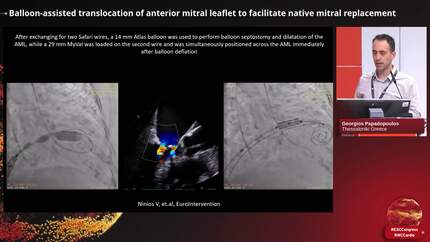
Left ventricular outflow tract (LVOT) obstruction is a major limitation of transcatheter mitral valve replacement (TMVR), especially in patients with severe mitral annular calcification (MAC) or prior annuloplasty. Balloon-assisted translocation of the anterior mitral leaflet (BATMAN) is a novel mechanical leaflet-modification technique that displaces the anterior mitral leaflet (AML) to prevent LVOT obstruction and facilitate stable valve anchoring.
We present a three-patient series demonstrating the feasibility and adaptability of BATMAN across valve-in-MAC and valve-in-ring procedures.
Following left atrial access with posterior–inferior transseptal puncture, an electrified 0.035″ wire was used to perforate the AML under TEE and fluoroscopic guidance. In MAC cases, perforation was targeted at the mid-A2 scallop, 5–7 mm from the base, avoiding the aortomitral curtain and calcific nodules. After exchange and placement of two stiff wires, a non-compliant balloon was advanced into the leaflet and inflated to create controlled tearing and anterior displacement, while serving as a buddy balloon/ buddy wire for valve delivery over the second wire. In the valve-in-ring case, the AML was perforated at its base, resulting in complete translocation of the entire leaflet to maximize LVOT expansion. MyVal transcatheter heart valves (Meril Life Sciences) were implanted under rapid pacing.
Three elderly patients (2 male, one female) with severe comorbidities and NYHA IV symptoms underwent TMVR with BATMAN. In the first case of circumferential MAC, baseline mean gradient was 12 mmHg with predicted neo-LVOT 80 mm²; BATMAN enabled implantation of a 29 mm MyVal with post-procedural mean gradient 3.0 mmHg. LVOT peak velocity of 2.1m/sec, and no paravalvular leak. The second patient with severe MAC (baseline gradient 11 mmHg, MVA 1.0 cm², predicted neo-LVOT 90 mm²) experienced slight atrial migration of the first prosthesis; valve-in-valve-in-MAC implantation restored competence with a mean gradient of 3.5 mmHg, LVOT peak velocity of 2.3m/sec, and only trace paravalvular regurgitation. The third case involved a rigid annuloplasty ring with recurrent stenosis (baseline gradient 8 mmHg, MVA 1.1 cm², predicted neo-LVOT 75 mm²); basal perforation and complete AML translocation allowed secure deployment of a 29 mm MyVal with a mean gradient of 3.0 mmHg, LVOT peak velocity of 1.9m/sec and no regurgitation. Across all patients, technical and device success was 100% with no procedural mortality, stroke, or conversion to surgery. At one-year follow-up, all three patients improved from NYHA IV to II, with stable valve function and no adverse events.
The BATMAN technique is a reproducible strategy for preventing LVOT obstruction in TMVR, enabling treatment of otherwise prohibitive anatomies with consistent hemodynamic success and durable clinical benefit, warranting systematic prospective evaluation. Figure
Contributors

You may be interested in