Feasibility and outcomes of single-guide catheter combined mitral and tricuspid transcatheter edge-to-edge repair
European Heart Journal Supplements


Abstract
Concomitant transcatheter mitral (M-TEER) and tricuspid (T-TEER) edge-to-edge repair has emerged as a valuable therapeutic strategy for patients with severe mitral regurgitation (MR) and tricuspid regurgitation (TR). The use of a single steerable guide catheter (SGC) for both valves may streamline the procedure and reduce invasiveness.
This study evaluated the safety, efficacy, and clinical outcomes of combined M-TEER and T-TEER performed with a single SGC.
From January 2022 to December 2024, 47 consecutive patients with moderate-to-severe (3+) degenerative or functional MR and severe TR in NYHA class III–IV underwent combined M-TEER and T-TEER using a single SGC at our center. Propensity score matching was applied to adjust for baseline differences in subgroup analyses. Echocardiographic and clinical data were collected at baseline, 30 days, and 1 year. Primary endpoints included procedural success, MR and TR severity reduction, and NYHA class improvement.
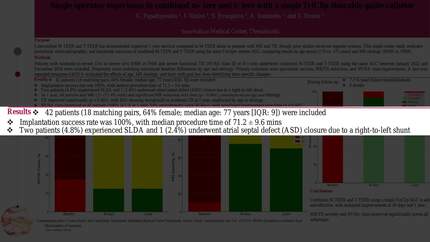
The cohort consisted of 47 patients (20 matched pairs; 64% female; median age 77 years [IQR: 9]). Procedural success was achieved in all cases, with mean device and procedure times of 39.4 ± 6.8 minutes and 71.5 ± 9.4 minutes, respectively. No in-hospital or 30-day major adverse events occurred, except for one atrial septal defect closure (2.1%). During a median follow-up of 0.82 years, heart failure hospitalization occurred in 4 patients (8.5%), with no deaths reported. At 30 days and 1 year, MR ≤2+ was maintained in all patients, with 72.3% having only mild MR at 1 year (Figure 1). MR severity reduction over time was significant (p<0.001), with post hoc testing confirming improvement from baseline to 30 days (p<0.001) and to 1 year (p<0.001), consistent across age (p=0.66) and MR etiology subgroups (p=0.08). TR severity also improved markedly, with 75% achieving trivial TR and 21% mild TR at 1 year (p<0.001), with sustained reduction from baseline to follow-up (p<0.001), unaffected by age (p=0.68) or MR etiology (p=0.87) (Figure 1). Functional status improved significantly, with all patients in NYHA class I–II at 1 year; 32% remained fully asymptomatic from 30 days onwards. NYHA class improvement over time was significant (p<0.001), with no interaction with age (p=0.54) or MR etiology (p=0.77) (Figure 1).
Combined M-TEER and T-TEER using a single SGC is safe, achieves durable MR and TR reduction, and improves functional status across patient subgroups, supporting its role in managing advanced bi-valvular regurgitation.
Contributors

You may be interested in