Reduced chest pain and quality-of-life and improvement after tailored therapy in diabetic patients with ischaemia with non-obstructive coronary arteries: findings from the INOCA-IT Registry
European Heart Journal Supplements


Abstract
Diabetes is associated with complex microvascular alterations; however, data on association to ischemia with non-obstructive coronary artery disease (INOCA) endotypes are limited and the effects of tailored therapy in diabetic patients are poorly investigated.
The aims of this subanalysis are to describe the prevalence of INOCA endotypes among diabetic patients and to evaluate their responsiveness to tailored medical therapy.
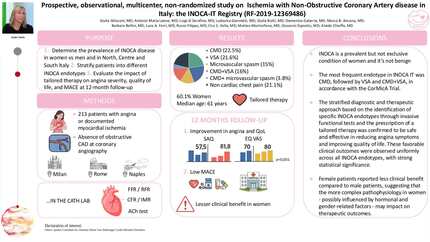
The analysis was performed on data from the INOCA-IT Registry(RF-2019-12369486), which consecutively enrolled patients with angina and/or inducible myocardial ischemia, without obstructive coronary artery disease (CAD), who underwent invasive coronary functional assessment including acetylcholine provocative testing. This subanalysis investigates the prevalence of INOCA endotypes in diabetic patients at coronary angiography, and the impact of a stratified therapy on angina severity and on QOL via the Seattle Angina Questionnaire(SAQ) and EQ-5D-5L questionnaire at baseline and at 12-months clinical follow-up.
Of 213 patients included in the registry, 29(13.6%) had diabetes. Diabetic patients were more often hypertensive and dyslipidaemic and had more frequently undergone previous PCI (27.6%vs11.4%, p=0.018). Conversely, the characteristics of angina upon presentation and angina severity were comparable to non-diabetic patients (atypical angina:10.3%vs10.6%, unstable angina:3.4%vs8.2, Canadian Cardiovascular Society(CCS) class≥3:41.3vs34.8%). At baseline, diabetic patients scored worse at Eq-5D-5L mobility and self-care domains, whereas summary SAQ and all elements of the SAQ score were comparable.
Coronary microvascular dysfunction (CMD) was the most frequent microvascular alteration among diabetic patients (55.2%), equally distributed between isolated presentation and combination with epicardial spasm (both 27.6%); diabetic patients also showed a trend towards lower coronary flow reserve (CFR) values (2.4[2.0-3.4]vs2.9[2.1-4.45], p=0.098).
Tailored therapy improved both the chest pain symptoms in terms of CCS class and SAQ summary score in both populations (p<0.001 –Figure 1); however, diabetic patients still showed significantly lower SAQ summary score at follow-up compared to non-diabetic patients (73.3 [66.4-82.1] vs 83.4 [68.7-95.5], p=0.009 –Figure 1b). Regarding QOL, the mobility and pain and discomfort domains of the Eq-5D-5L scores showed improvements, while the others did not. The EuroQol Visual Analogue Scale (EQ VAS) showed significant improvements compared to baseline in diabetic patients (50 [50-70] vs 70 [60-80], p<0.001), but remained lower than in non-diabetic patients at follow-up (70 [60-80] vs 80 [70-90], p=0.011 –Figure 2).
Among diabetic patients, CMD was the most common microvascular alteration. Responsiveness to tailored therapy was achieved in most domains but remained less effective than for non-diabetic patients.
Contributors



L Di Serafino
Author
G Ghizzoni
Author
L Giannetti
Author

C Giuliana
Author

L Ciaramella
Author
G Vitale
Author
C Trani
Author
F Burzotta
Author
G Esposito
Author

You may be interested in